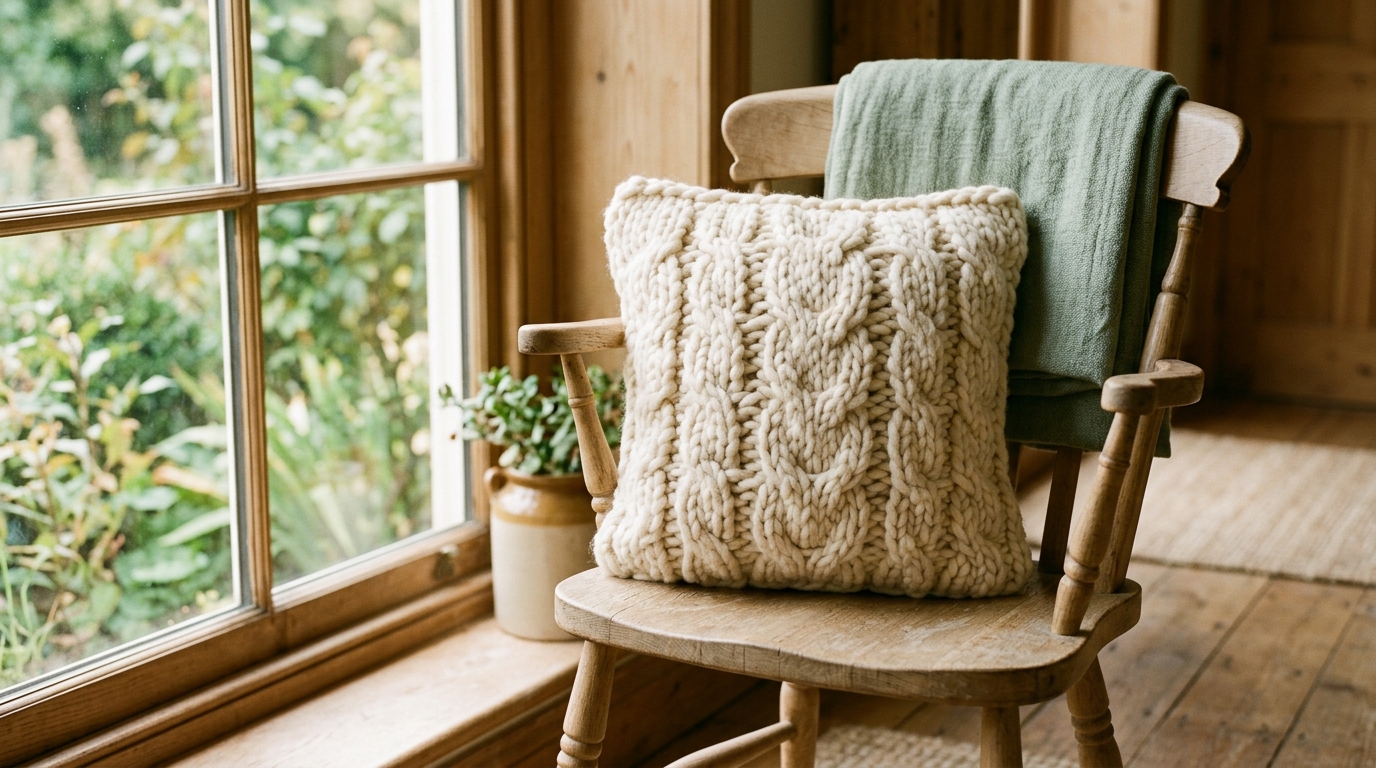
Quick answer: A pillow cover is the one project where you can work the yarn out exactly, because the insert fixes the area before you start. An 18 by 18 cover takes about 64 yards of #7 jumbo worked by hand, or about 320 yards of #6 super bulky worked with a hook. Same pillow, five times the yarn. Decide the yarn class first, then count skeins.
Four methods are here, and a method got in only if a published project put a finished pillow size next to a named yarn and a skein count. That is a low bar and most tutorials for how to make a chunky yarn pillow still miss it: they show the pillow, skip the yardage, and leave you guessing at the shop. One method that clears the bar on paper is left out anyway, for a reason in the yarn band, and it is named below.
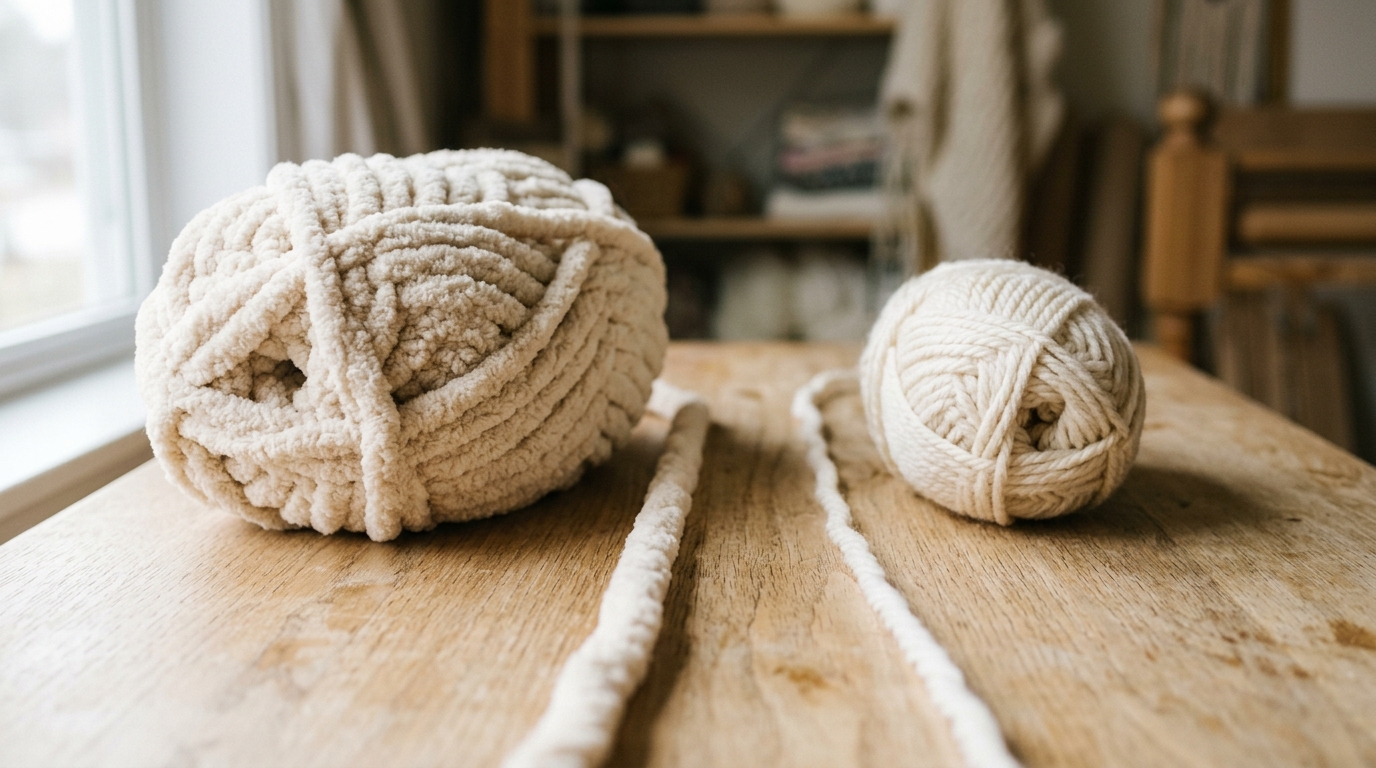
The word chunky covers a 5.3 times spread in yards per ounce. Bernat Blanket Big is 300 g, 10.5 oz, 32 yards, which works out at 3.0 yards per ounce. Lion Brand Hometown is 5 oz and 81 yards, which is 16.2 yards per ounce. Both get called chunky in pattern titles. A skein count copied from a pattern written for one of them is meaningless for the other, and on a pillow the error is easy to see, because the insert does not change size to accommodate your miscalculation.
What you need before the first stitch
- The pillow form, bought first. Standard sizes are 14, 16, 18 and 20 inches square. The form is your pattern; everything else is measured off it.
- A yarn with its class printed on the band. #7 jumbo works in the hands. #6 super bulky needs a tool. Hometown’s own band suggests a 9 mm hook or 9 mm needles for it, which tells you it is not a bare-hands yarn.
- Yards per skein, written down. Not ounces, not grams. Yards.
- A hook or needles sized to the yarn. A P hook at 11.5 mm for super bulky single crochet, or size 35 needles for a chunky 54 yard skein, or size 50 at 25 mm for jumbo if you would rather not use your arms.
- Polyfil, only if you are making a stuffed shape rather than a cover. The round finger knit version below is stuffed; the three square ones go over a form.
 Pin it
Four ways to make the cover, and who each suits
Hand knitting jumbo, no needles
Bernat Blanket Big at #7 jumbo, 100% polyester, knits at 2.5 stitches and 3.5 rows to a 4 inch square on 25 mm needles, which is thick enough to hold a stitch on your fingers alone. One maker covered an 18 by 18 form with about two skeins, using part of the second, and built the piece by chaining long enough to reach across the pillow rather than counting stitches.
Best for: the first chunky yarn pillow, and for anyone who wants it done in one sitting. Not for a matched pair, because this yarn is discontinued in most colourways and the shade you buy today may have no twin next month.
Knitting a chunky 54 yard skein on size 35 needles
The most predictable of the four, because the numbers are all stated: cast on 30 stitches, work 58 rows, use three skeins of 3.5 oz and 54 yards each, and fit it over a 16 by 16 pillow form. Two hours, start to finish.
Best for: anyone who wants a knitted pillow cover with a recipe rather than a judgement call. The stated row count is what makes it repeatable, and repeatable is what you want if you are making three for a sofa.
Single crochet in super bulky
Chain 29, single crochet, US size P hook at 11.5 mm, Lion Brand Hometown in a solid, just under four skeins for an 18 by 18 pillow. One stitch, no shaping, no counting past the first row. This is the densest fabric of the four and by far the heaviest on yarn, which is the whole point of the arithmetic in the table below.
Best for: a crochet pillow cover that holds its shape on a chair nobody is careful with. Hometown is 100% acrylic and the band allows a machine dryer at the hottest available setting, which no other yarn here permits.
Finger knitting a round pillow
Not a cover at all. One skein of jumbo, worked with fingers only, stuffed with Polyfil, finishing at about 10 inches across. It is the only one of the four that does not need a form, and the only one that comes together in well under an hour.
Best for: a small accent cushion, a first project for a child, or filling a gap in a pile of square pillows. Not for anything that has to match a standard insert, because there is no standard 10 inch round insert to match.
The method I left out
Hand knitting a super bulky yarn without needles. It photographs the same as the jumbo version and the yarn is far easier to buy, but the band settles it: Hometown’s suggested needle is a #13 at 9 mm and its knit gauge is 9 stitches and 12 rows to 4 inches. A strand that needs a 9 mm needle does not hold a loop on a bare hand, so the stitches slide, the tension collapses, and the fabric ends up as a limp net over the form. Super bulky belongs on a hook or on needles. Jumbo belongs in your hands. They are one category apart and it is the category that decides, not the word on the pattern title.
 Pin it
Six steps to a finished pillow cover
1. Buy the form before the yarn
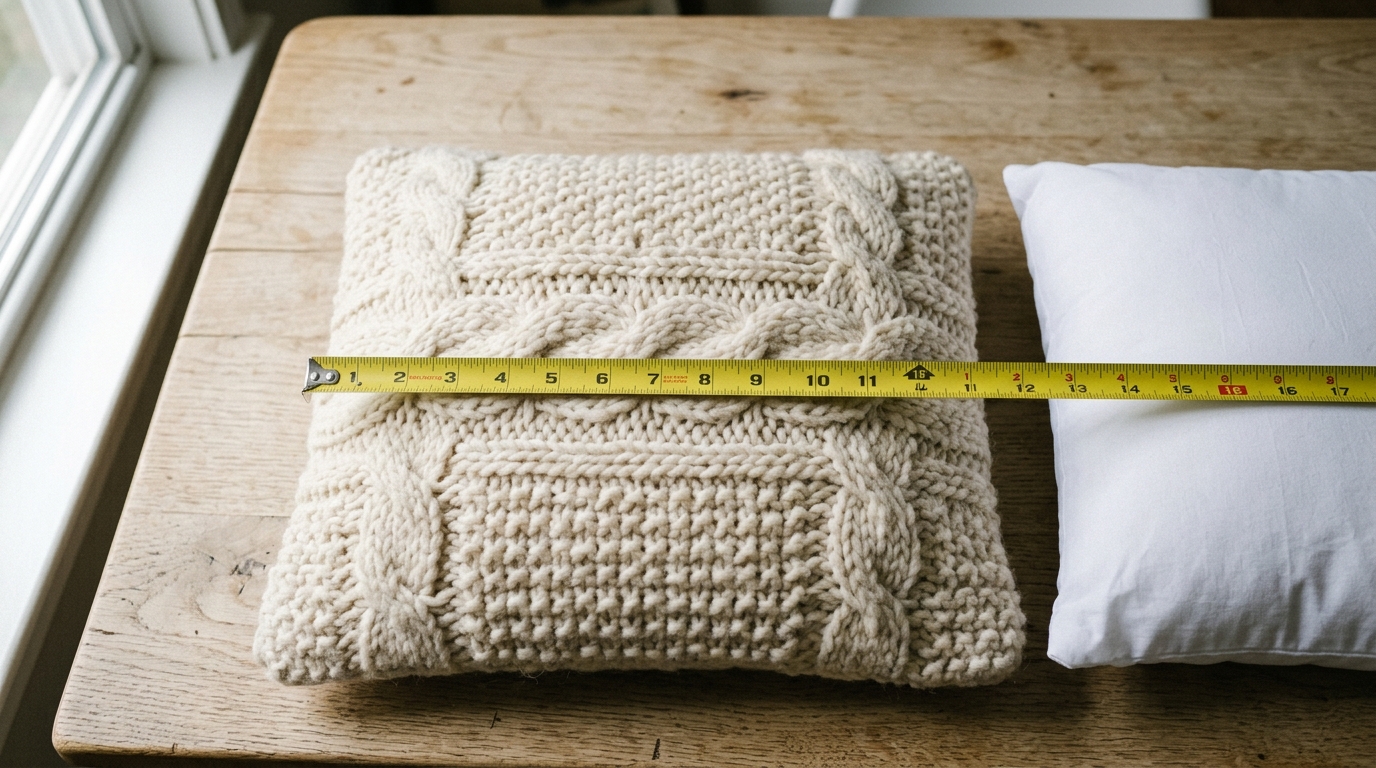
Measure it flat across, corner seam to corner seam. A form sold as 18 inch is 18 inches across when it is squashed flat, and that is the number your cover has to reach.
2. Work out the area, both faces
Width times height, doubled, because a cover has a front and a back. An 18 inch square is 324 square inches per face and 648 for the pair. That single number is what the table below turns into yards.
3. Convert to yards for your yarn class, then to skeins
Jumbo worked by hand covers about 10.1 square inches per yard. Super bulky worked in single crochet covers about 2.0. Divide your area by the right figure, then divide the yards by the yards printed on the skein. Round up, and add one skein.
4. Swatch twenty stitches and measure them
Not for the gauge on the band, for yours. Hand tension varies more at this thickness than at any other, because there is no needle holding the loop to a fixed size. Twenty stitches laid flat under a tape tells you whether your chain of 29 will actually reach 18 inches.
5. Work to length, checking against the form
For a folded cover, keep going until the piece is twice the height of the form plus a little ease, then fold it in half around the form and check before you seam. The published example that works this way ran to 58 rows for a 16 inch form, but that row count belongs to that maker’s tension and that yarn.
6. Seam three sides, insert, then close the fourth
Use the working yarn, not a thinner one, and sew through the outer loops so the join sits flat. Leave the fourth side openable so the cover washes separately from the form, which is the part that cannot go in a machine.
Pillow size to yarn, by method
Both faces are included. Skein counts assume 32 yards for jumbo and 81 yards for super bulky, and every count already has the spare skein in it.
| Pillow form | Hand knit, #7 jumbo | Single crochet, #6 super bulky |
|---|---|---|
| 14 by 14 inches | about 39 yards, 3 skeins | about 196 yards, 4 skeins |
| 16 by 16 inches | about 51 yards, 3 skeins | about 256 yards, 5 skeins |
| 18 by 18 inches | about 64 yards, 3 skeins | about 324 yards, 5 skeins |
| 20 by 20 inches | about 79 yards, 4 skeins | about 400 yards, 6 skeins |
Washing, and why it matters more on a pillow than a blanket
A blanket gets folded over the end of a sofa. A pillow gets sat on, leaned into and held, so it will be washed several times a year rather than once. Which means the care line on the band stops being a footnote and becomes the reason to pick one yarn over another.
Lion Brand Hometown, 100% acrylic. Machine wash with the initial water temperature not exceeding 40°C or 105°F, no bleach, and a machine dryer may be regularly used at the hottest available temperature setting. That last clause is unusually generous and it is the strongest argument for the crochet route.
Bernat Blanket Big, 100% polyester. Gentle cycle machine wash in warm water, do not bleach, tumble dry low, do not dry clean, do not iron. Fine, but low heat only, and heat is what flattens the pile that made you want the yarn.
The form itself. Take it out. A polyester insert soaks up several times its weight in water and takes days to dry through the middle, and it comes out lumpy.
Four ways a chunky pillow goes wrong
Sizing the cover to the form’s label. Forms are cut generously so they look full. Measure the one in front of you flat, and add nothing for stretch, because chunky fabric stretches on its own once the form is inside.
Making the cover exactly the form’s size. The opposite mistake, and the more common one. A cover with no ease at all pulls the stitches open and the form shows through as pale patches between them. Half an inch of ease on each dimension is enough.
Buying a discontinued colourway for a set. Planning two or three matching pillows means checking that the full count is in stock in one colourway before the first stitch. Bernat Blanket Big is already discontinued in most of its shades.
Sewing the seam with thin yarn. It cuts into the chunky stitches under load and the seam line goes wavy after a month of use. Seam with the same strand you knitted with.
The same yarn maths runs blankets, only with a bigger area and no form to measure against. If a matching throw is next, our guide to yarn blankets by hand has the coverage figures for four hand methods, and the chunky yarn blanket guide covers #10 jumbo chenille specifically.
FAQ
How many skeins for a diy pillow cover in chunky yarn?
For an 18 by 18 form, three skeins of #7 jumbo at 32 yards each, or five skeins of #6 super bulky at 81 yards each. Both counts include one spare. Check your skein’s printed yardage before trusting either, because both classes are sold as chunky.
Can I make a knitted pillow cover without knitting needles?
With #7 jumbo, yes, your hands are enough. With #6 super bulky, no. Its own band suggests a 9 mm needle, and a strand that fine slides off a finger before the next stitch is formed.
What are the easiest crochet pillow designs for a first attempt?
A single crochet rectangle folded in half and seamed on three sides. Chain 29 for an 18 inch form, work in single crochet with a P hook at 11.5 mm, and never change stitch. Every other crochet pillow design is that rectangle with something added.
Is a round pillow pouf diy kit the same as this?
No, and the difference is the filling. A pouf is stuffed to hold a person’s weight and needs a firm fill and a flat base. The round finger knit pillow above takes Polyfil and finishes at about 10 inches across, which is a cushion, not a seat.
Does throw pillow sewing beat knitting for speed?
On a sewing machine, yes, easily. By hand, no. The knitted version above takes about two hours including the seams, and hand-sewing a fabric cover with a concealed opening takes longer than that once you account for pressing and pinning.
Can I make a heart pillow with ruffles from chunky yarn?
The heart shape works, the ruffles do not. Ruffling needs many small stitches gathered along an edge, and at 2.5 stitches to 4 inches there are not enough stitches on an entire pillow edge to gather anything. Save ruffles for a fine yarn or fabric.
Will a diy mini pillow use less than one skein?
Yes. Anything under about 10 inches square comes in under a single 32 yard jumbo skein, which makes small pillows the sensible way to use up what is left after a bigger cover.
The same 5-to-10% sizing gap shows up in crochet cushion covers, where only 8 of 24 patterns checked state both sizes. Baby blankets have the same problem at scale — only 2 of 42 baby blanket patterns with a stated size land on the supposed 30x40in standard. And 20 of 30 patterns labeled beginner in small knitting projects for beginners actually need a skill a first-timer doesn’t have.
Key takeaways
- Chunky spans 3.0 to 16.2 yards per ounce. The class number on the band, #6 or #7, decides everything else.
- Buy the form first and measure it flat. The form is the pattern.
- Count both faces: an 18 inch square cover is 648 square inches of fabric, not 324.
- Jumbo works in the hands, super bulky needs a hook or needles. They are not swappable.
- Take the form out before washing, and check the band for dryer heat, because only acrylic here allows a hot machine dry.

The yarn that makes a pillow cover hold its shape
Chenille thick enough to keep the cover firm over an insert, and soft enough to sit against.
See the top pick →