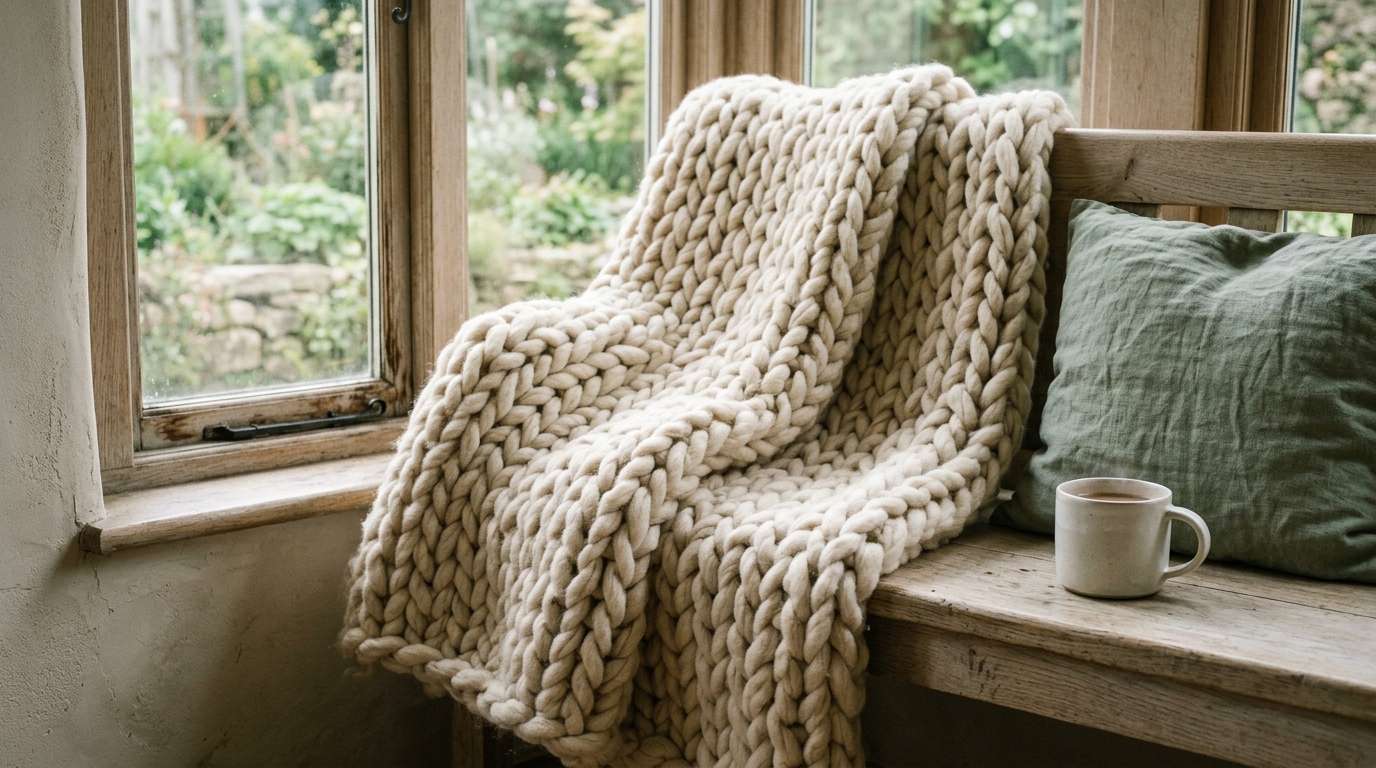
Quick answer: Four hand methods made it into this guide, and they are not interchangeable. Arm knitting jumbo yarn covers about 11.3 square inches per yard. Finger knitting loop yarn covers about 28.3 square inches per yard. Same yardage, two and a half times the blanket. So a sofa throw of 130 by 170 cm needs about 305 yards one way and about 122 yards the other. Pick the method first, then buy for that method’s number.
A method got in here only if two things were on record for it: a finished blanket with its measurements next to the yarn that made it, and a manufacturer’s washing instruction for that fibre. Everything sold as a hand knit blanket kit but published without a finished size stayed out. That rules out most of what a search for yarn blankets by hand diy returns, and it rules out one of the most photographed fibres in the category, named below with the reason.
Yardage does not travel between methods. Flax and Twine’s arm knit blanket finishes at 36 by 44 inches from 140 yards of jumbo yarn, which is 1,584 square inches, or 11.3 square inches for every yard. Six skeins of 18 yard loop yarn, 108 yards in total, finger knit to roughly 51 by 60 inches, which is 3,060 square inches, or 28.3 square inches per yard. Carry the first number into the second project and you buy nearly three times the yarn you need.
What a hand made blanket actually needs
- Yarn thick enough to hold a stitch without a tool. Anything labelled jumbo, which is weight category 7, or a loop yarn made for finger work. Bulky is not jumbo. Bulky is category 5 and needs a hook.
- The skein’s yardage, not its weight. Bernat Alize Blanket-EZ prints 180 g and 16 meters, 18 yards. Lion Brand Yooge comes as one 2,300 g skein. Neither number tells you anything until you convert it to area, which is what the table below does.
- A tape measure. Not a stitch count. Width in centimetres, checked as you go.
- Your two arms, or one hand. Arm knitting uses both forearms as needles. Loop yarn uses one finger through the pre-made loops.
- The full yarn order in one batch. Dye lots shift between production runs, and the shade you match today is not the shade that ships in three weeks.
 Pin it
The four hand methods, and who each one is for
Arm knitting jumbo yarn
Your forearms are the needles. Flax and Twine’s version finishes at 36 by 44 inches on 140 yards, and the yarn band for that weight gives a gauge of 3.5 stitches and 5 rows in a 4 inch square knit on size US 50 needles in garter stitch. US 50 means 25 millimetres across, roughly the diameter of a broom handle, which is the closest tool equivalent to a human forearm.
Best for: the maker who wants a visible, chunky, open stitch and a blanket finished in an afternoon. Worst for anyone who needs to put the work down mid-row, because live stitches sitting on your arm cannot be parked.
Finger knitting loop yarn
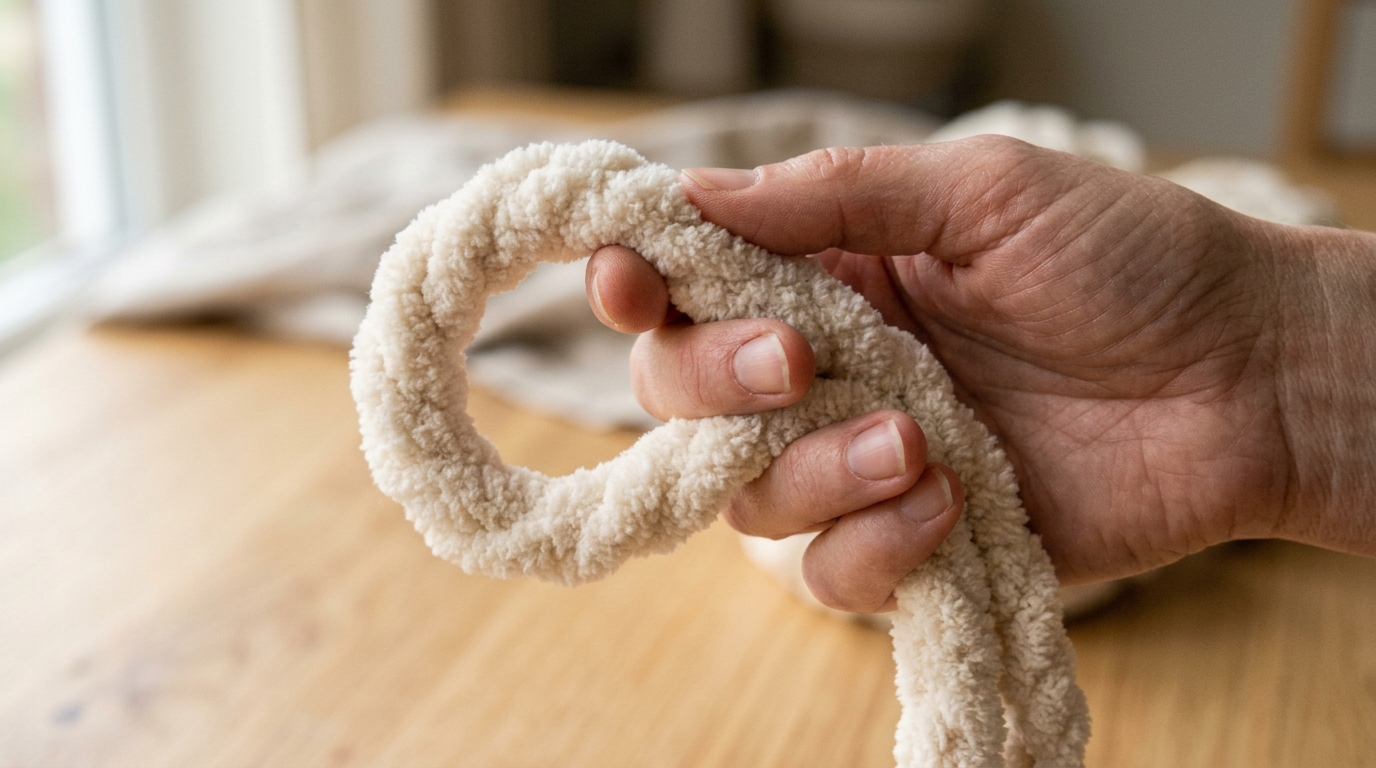
The loops are made at the factory, so you pull one loop through the next with a single finger and no tool at all. This is the method behind the 28.3 square inches per yard figure, and it is the most yarn-efficient of the four by a wide margin. Bernat Alize Blanket-EZ is 100% polyester at #7 jumbo, and the band says machine wash on a delicate cycle, no bleach, no dry cleaning, no iron, tumble dry gentle.
Best for: a first blanket, and for anyone who will wash it often. One maker who did the whole thing this way estimated around 15 hours of work and confirmed the yarn is machine washable and dryable.
Hand crochet with big yarn
Same jumbo yarn, but you loop it round your hand instead of round a hook. Mama in a Stitch’s lapghan is worked from a chain of 10, giving 9 stitches across, and finishes at 26 by 41 inches from one 2,300 g skein of Lion Brand Yooge. The instruction that matters is a single line: crochet very loosely for best results.
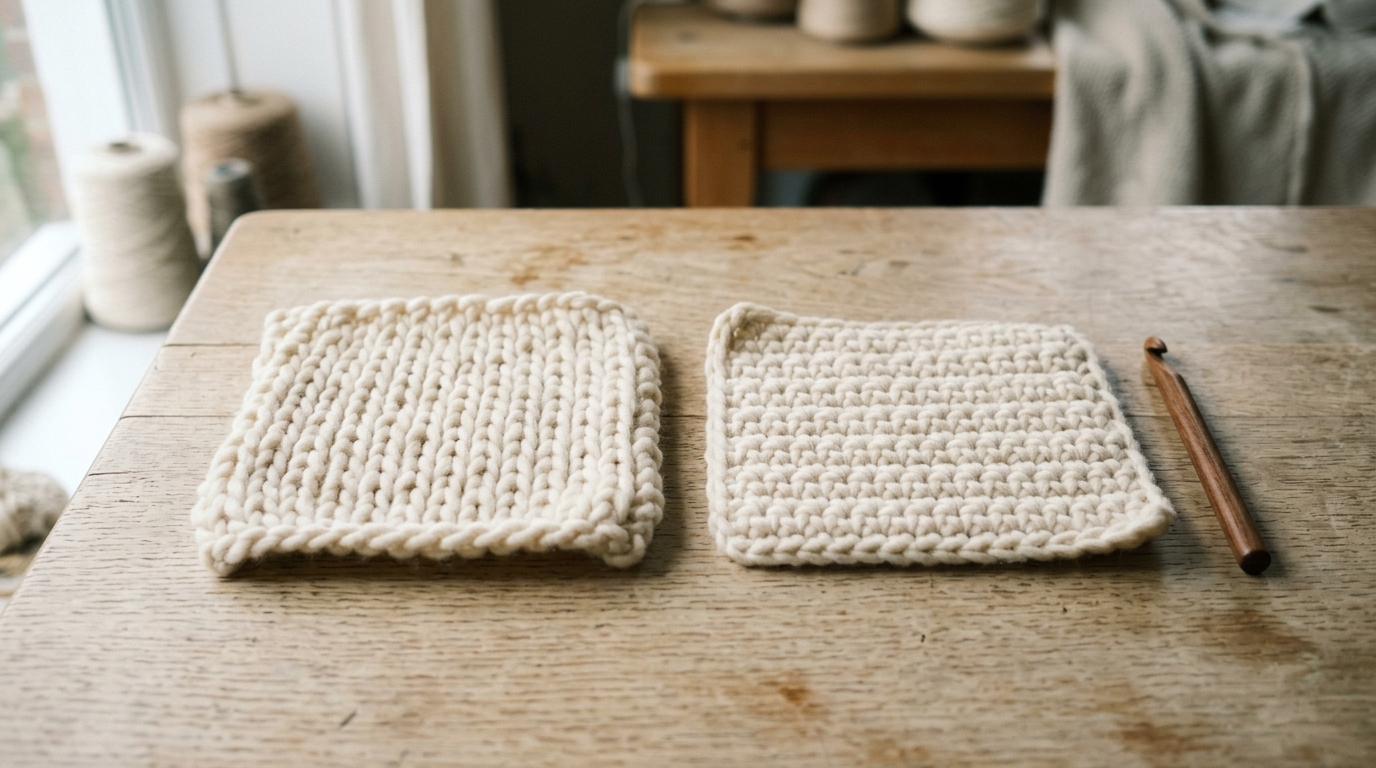
Best for: anyone who already crochets and wants the same fabric at four times the speed. The pattern’s own note is worth quoting for what it tells you about tension: when made by hand you get a looser fabric and a slightly larger blanket, while the hook creates a tighter fabric and a smaller blanket in most cases. If you swap to a hook to feel in control, you are also signing up for a smaller finished size from the same yarn.
Hand knitting tube yarn
Tube yarn is a knitted casing rather than a spun strand, and it behaves differently under the hand: less stretch, more body, and no shedding. Woolly Mahoosive’s Get Stuffed tube yarn produces an arm knitted blanket of roughly 70 by 85 cm per kilogram, and their Mammoth range can be machine washed on a gentle cool cycle with a slow short spin, then dried flat and pulled to shape.
Best for: a blanket that lives on a sofa with a dog on it. The casing is thin and light so the yarn stays soft, and it does not shed at all.
The one I left out, and why
Merino roving. It is the fibre in every photograph you have saved, it has the best area yield of anything here at roughly 775 square inches per kilogram against 463 for tube yarn. It is out of this guide because the manufacturer’s own care line for it reads: it can be spot cleaned or dry cleaned. That is not a washing instruction for a blanket somebody sleeps under. Roving is not chenille and it is not tube yarn, whatever a listing photograph suggests, and a first hand made blanket in it will be beautiful for about four months.
 Pin it
Seven steps from an empty table to a finished blanket
1. Decide the finished size in centimetres first
A lap blanket around 100 by 130, a sofa throw around 130 by 170, a twin cover around 170 by 220. Write it down before you look at yarn. Every number after this one depends on it.
2. Convert your size to square inches, then divide
Length times width in inches gives the area. Divide by the square inches per yard for your chosen method, from the table below, and you have the yardage. Divide that by the yards printed on the skein and you have the count. This is the whole calculation, and it is the reason a skein number copied from someone else’s project is meaningless to yours.
3. Order the whole count in one go
Plus one spare. Dye lots change between production batches, and the mismatch does not announce itself until the new skein is already in the middle of your blanket. If the colourway is short on stock for the full count, choose a different colourway rather than ordering in two waves.
4. Make a swatch before the blanket
Twenty stitches, five rows, then measure it flat with a tape. Two makers with the same yarn and the same method produce different widths, because hand tension is personal and no pattern can correct for yours. The swatch is ten minutes and it is the difference between the blanket you planned and one that comes out narrow.
5. Cast on by the tape, not by the stitch count
Lay your loops out along the tape until they reach your target width, then start. A pattern’s stitch count assumes the pattern writer’s tension. Your tape does not assume anything.
6. Join a new skein with an overlap, never a knot
Lay the last few inches of the old strand alongside the first few inches of the new one and work the doubled section as if it were single. With jumbo yarn nobody will find the join. A knot, on the other hand, sits as a hard lump in a soft blanket forever, and on a chenille or tube yarn it can also chew through the casing.
7. Measure the width every fifth row
Tension drifts as your hands warm up and again as they tire. Drift of half a centimetre a row is invisible while you work and obvious when the blanket is off the table. Five rows is often enough to catch it and rip back cheaply.
Size to yarn, by method
Read the row for the method you picked in step 1. The middle column is what this whole article exists to give you.
| Method | Coverage per yard | Sofa throw, 130 by 170 cm |
|---|---|---|
| Arm knitting, jumbo yarn | 11.3 square inches | about 305 yards |
| Finger knitting, loop yarn | 28.3 square inches | about 122 yards, roughly 7 skeins at 18 yards |
| Hand crochet, big yarn | 463 square inches per kg | about 7.5 kg |
| Hand knitting, tube yarn | 70 by 85 cm per kg | about 3.7 kg |
The two bottom rows are quoted by weight rather than yardage because that is how those yarns are sold, in kilograms with no yardage printed at all. Woolly Mahoosive’s published figures run the same way: 1 kg arm knitted makes around half a square metre, 2 kg makes approximately 70 by 145 cm, and 4 kg makes approximately 145 by 145 cm.
Washing, by fibre and nothing else
 Pin it
Polyester loop yarn. Machine wash on a delicate cycle. No bleach, no dry cleaning, no iron, tumble dry gentle. This is the band instruction for Bernat Alize Blanket-EZ, and it is the most forgiving of the four.
Tube yarn. Machine wash gentle and cool with a slow short spin, then dry flat and pull back to shape. Do not hang it wet, because a blanket this heavy will stretch itself out of square on a line.
Merino roving. Spot clean or dry clean. That is the whole list.
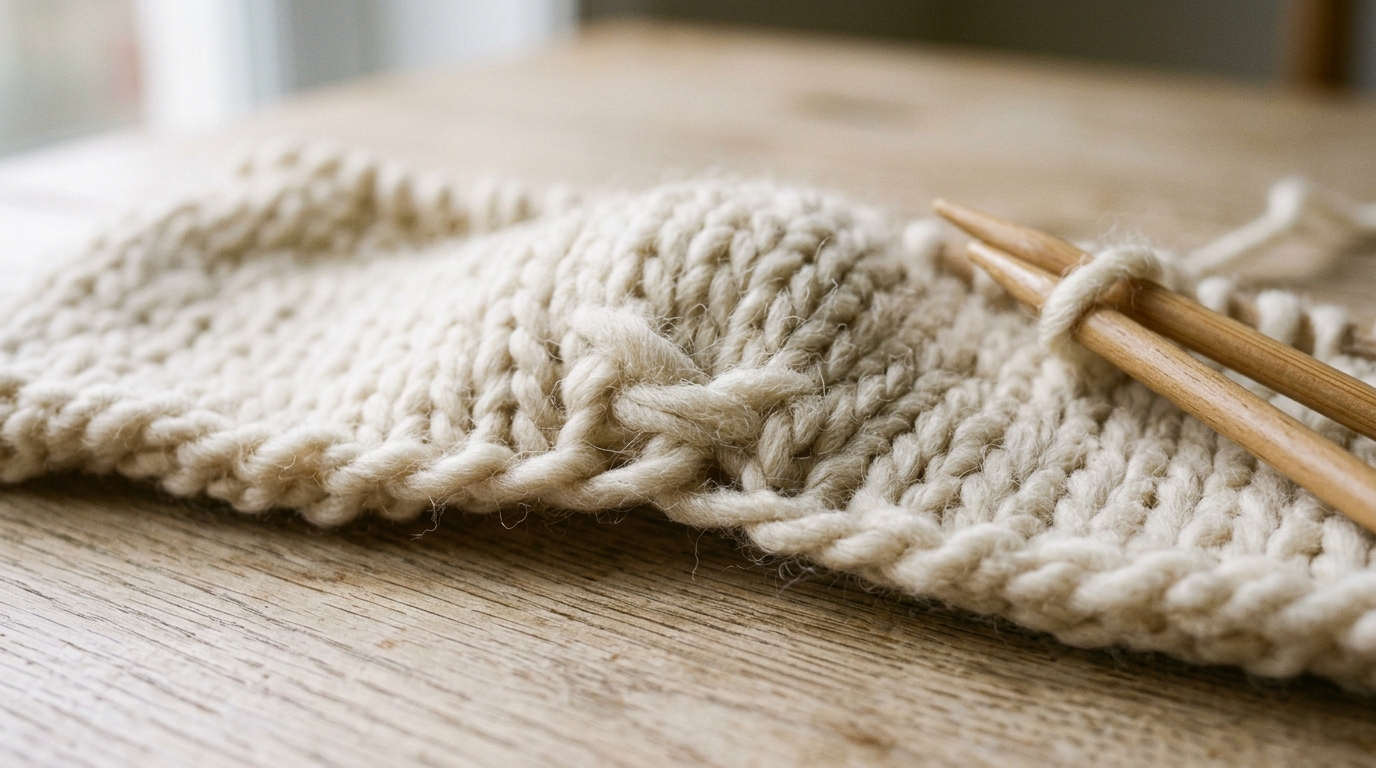
Any of them, after a wash. Trim off any bobbles that have formed. Cutting them flush is correct and does not unravel anything.
Four ways a hand made blanket goes wrong
Working tight because tight feels neater. It is not neater, it is smaller. Every pattern in this niche that says anything about tension says the same thing: work loosely. A tight hand costs you coverage on yarn you have already paid for.
Reading a weight as a yardage. A 2,300 g skein and an 18 yard skein are both sold as one skein. If a pattern says six skeins and you do not know which kind, you know nothing. Check the yardage or the grams before the count.
Buying by the photograph. Roving, chenille and tube yarn all shoot identically. They wash completely differently, and only one of the three survives a machine.
Hanging it wet. Dry flat, pull to shape. A wet jumbo blanket over a line is carrying several kilograms on the stitches at the top, and it will not go back.
If you would rather work the same yarn with a tool and get a denser fabric, the trade-off is a smaller blanket from identical skeins. Our crochet blanket guide for beginners covers that route, and the chunky yarn blanket guide has the per-skein area arithmetic for #10 jumbo chenille specifically.
FAQ
How do I make yarn thick enough to knit with my hands?
You do not spin it, you double it. Working several strands of a thinner yarn together as one is the standard route to a hand-workable thickness, and it is what one buyer of a jumbo chenille resorted to when the strand arrived thinner than its label claimed. Braiding or holding strands together changes your coverage per yard, so re-measure with a swatch rather than reusing the single-strand figures above.
Do acrylic yarn projects work for a hand knit blanket?
Yes, and the loop yarn method above is one of them. Acrylic and polyester are the fibres with the honest machine-wash instructions in this category, which is exactly why they are the ones I recommend for a first blanket.
Can I use big yarn crochet ideas from a hook pattern for hand work?
The stitches transfer, the sizing does not. Worked by hand you get a looser fabric and a slightly larger blanket than the same pattern gives on a hook, so take the pattern’s stitch sequence and recalculate the finished size from your own swatch.
What about crochet ideas for multicolored yarn?
Multicolour is where the dye lot problem bites hardest, because a mismatch shows in two shades instead of one. Order the entire count in a single batch, and if you are working stripes, cut and rejoin at the row edge rather than carrying strands up the side, where jumbo yarn makes a visible ridge.
Is pompom yarn crochet the same as loop yarn?
No. Pompom yarn carries fixed pompoms on a thin core strand and the core is what holds the stitch, so it does not hand-work like a jumbo strand. Loop yarn is uniform thickness all the way along and the loops themselves are the stitches.
Can I add yarn embroidery on crochet once the blanket is done?
On a hand made blanket the stitches are large enough that surface embroidery sits between them rather than on them, so it reads as loose thread rather than decoration. If you want the effect, work the colour change into the rows instead.
How long does one of these take?
One maker who finished a loop yarn blanket did not time it precisely and estimated somewhere around 15 hours. Arm knitting a smaller throw is faster than that, and hand crochet with a 2,300 g skein sits somewhere in between.
The exact-yardage method also works for a project with a fixed area, like how to make a chunky yarn pillow.
The same yardage check applies across the board — see chunky yarn projects for the 16-to-315-yard range per skein, baby blanket patterns for the missing-size problem in most roundups, small knitting projects for beginners for the skill gap behind the beginner label, and crochet blanket borders for reading border stitch count straight off the gauge.
Key takeaways
- Coverage per yard changes 2.5 times between hand methods, from 11.3 square inches arm knitting jumbo to 28.3 finger knitting loop yarn. Never move a skein count between projects.
- Size in centimetres first, convert to square inches, divide by the method’s coverage, then look at skeins.
- Order the whole count plus a spare in one batch, because dye lots shift between production runs.
- Swatch, cast on by the tape, and re-measure the width every fifth row.
- Polyester and tube yarn go in the machine on a cool gentle cycle and dry flat. Merino roving does not go in at all.

The jumbo yarn these hand methods are sized for
Every width and skein count on this page was worked out on jumbo chenille. Same yarn, same numbers.
See the top pick →