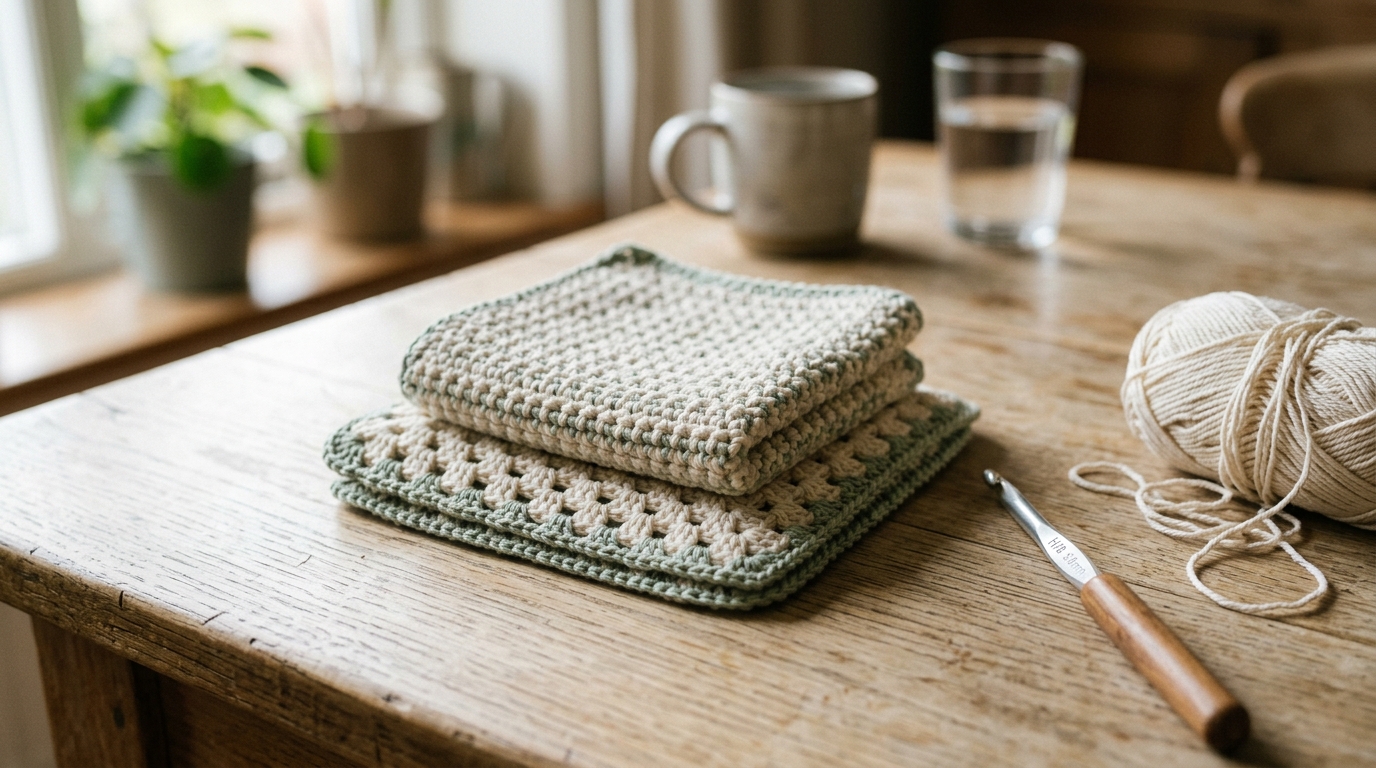
Quick answer: Four items made the list, and all four are small on purpose. An 8 inch dishcloth is 728 stitches, which is how many you work before you find out whether your tension is even. The scarf everyone recommends as a first project is about 4,200 stitches, and it hides the same mistake five times longer. Start where the feedback is fastest.
An item got in here only if a published pattern gave a finished size, a hook size and a yarn whose gauge is printed, so you can check your own work against a number instead of against a photograph. That criterion knocked out most of what a search for crochet items for beginners turns up, and it knocked out the single most recommended first project in the craft. That one is named below with the arithmetic behind the decision.
Lily Sugar’n Cream in worsted cotton crochets at 13 single crochet and 14 rows to a 4 inch square on a 5 mm hook. Run that through the standard beginner projects and you get the real difference between them. An 8 inch dishcloth is 26 stitches by 28 rows, 728 stitches. A 60 by 6 inch scarf is 20 stitches by 210 rows, about 4,200. A 40 by 50 inch blanket is roughly 22,750. Uneven tension appears at the same rate in all three. Only the first one tells you about it the same evening.
The tools, and the two that beginners buy wrong
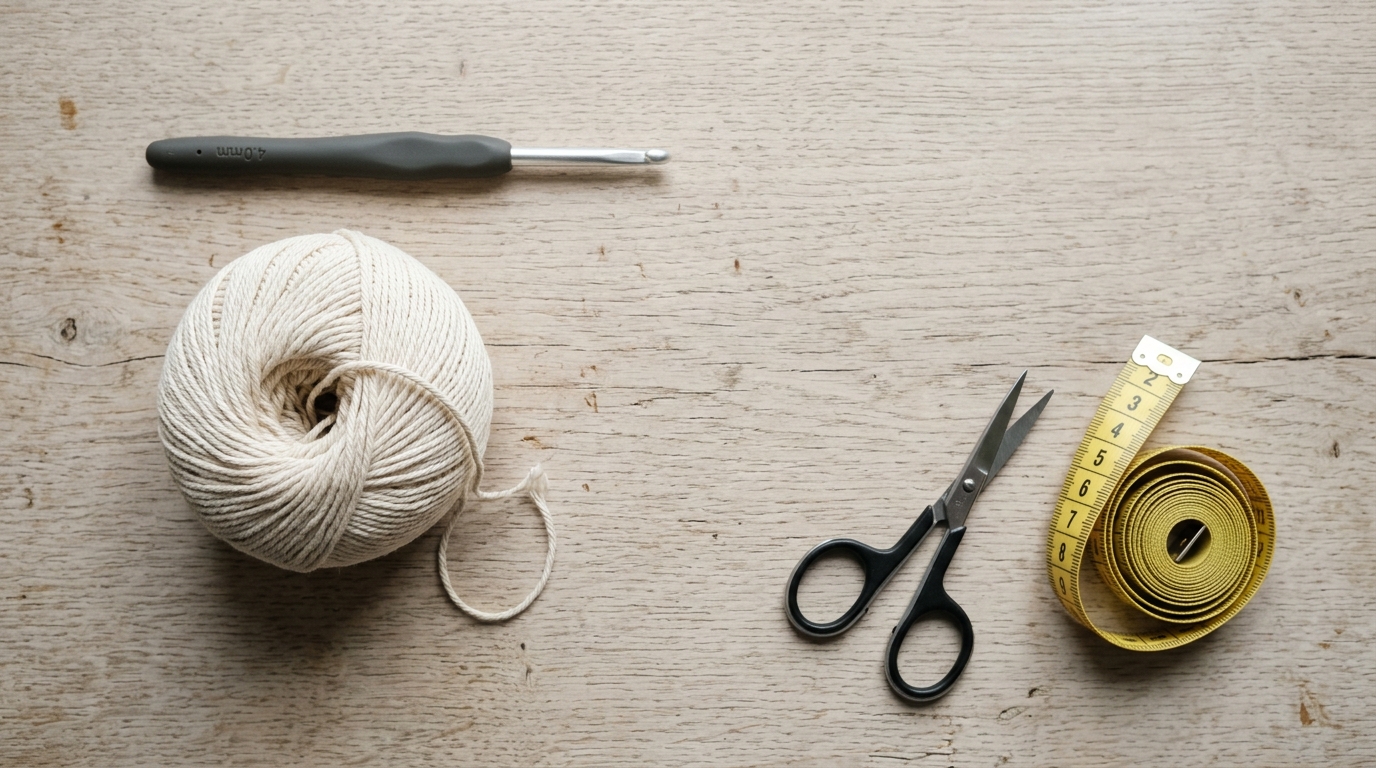
- A 5 mm hook, size H/8. This is the size every pattern below calls for and the size printed on the band of worsted cotton. Buy it first, buy one, and use it until it feels boring.
- Worsted weight cotton, 71 g and 120 yards a ball. Cotton because it is absorbent and easy to care for, which is what makes a dishcloth worth finishing, and because it shows stitch definition sharply enough that you can see your own mistakes.
- A tape measure. The single most-skipped tool in beginner crochet. Row counts lie, tape does not.
- Scissors and a blunt darning needle. That is the entire kit.
- Not a hook set. A pack of fourteen sizes teaches you nothing and gives you thirteen ways to accidentally work the wrong gauge.
- Not a Tunisian hook, yet. More on why in the FAQ.
 Pin it
Four crochet projects for beginners, in the order they teach you something
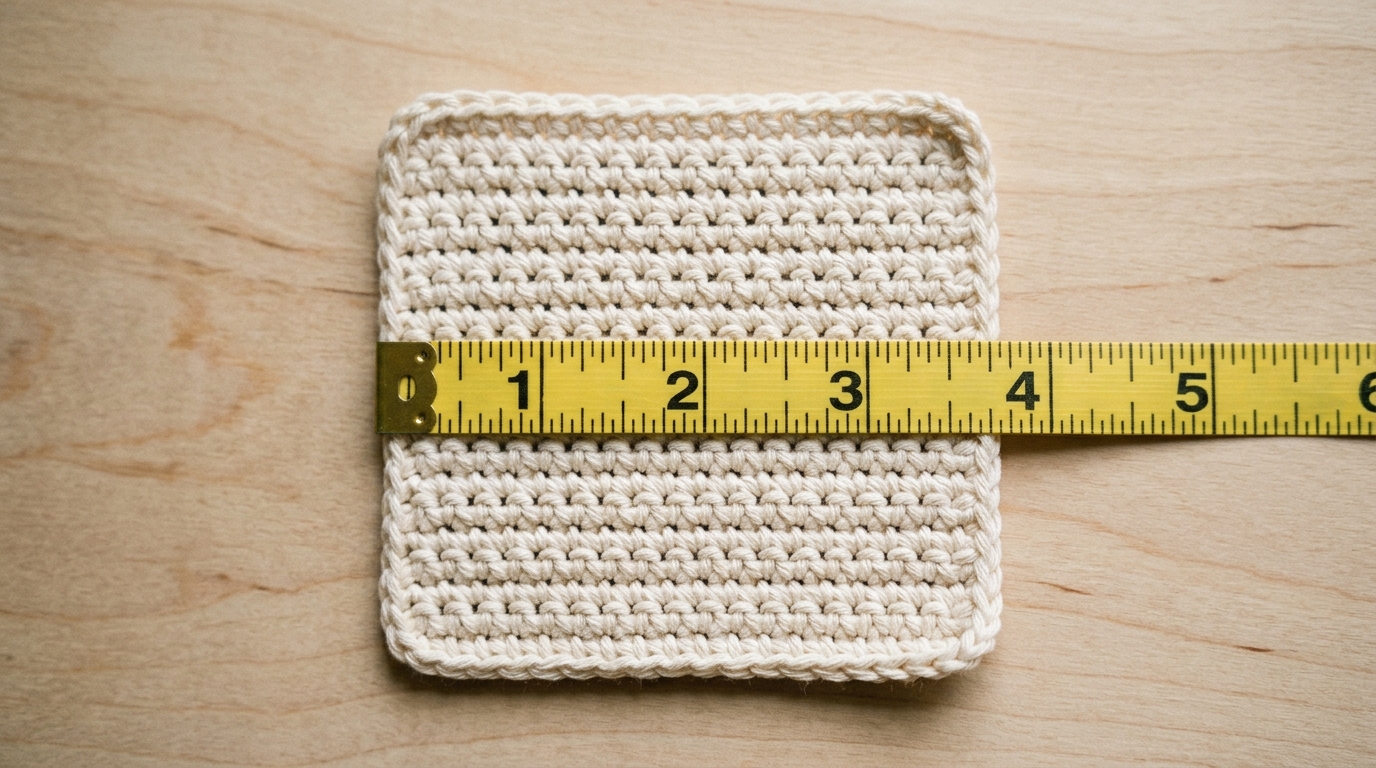
1. The basic dishcloth, 8 inches square
Single crochet only, a 5 mm hook, one ball, approximately 8 inches square when finished. This is the project that teaches the one skill everything else depends on: putting the same amount of yarn into every stitch. At 26 stitches across, a drift of even one stitch per row shows as a visibly slanted edge by row 20, which is exactly what you want the first time. Wash colours separately, because some colours may run.
Best for: the absolute first thing anyone crochets. It is also the only project on this list you will genuinely use every day afterwards.
2. The granny dishcloth, 10 inches square
Same 5 mm hook, worked in rounds rather than rows, finishing at approximately 10 inches square. Rounds are forgiving in a way rows are not: tension drift spreads evenly around the square instead of stacking up along one edge, so the piece stays square even when your stitches are not yet identical.
Best for: the second project, and for anyone who found the straight-edge dishcloth discouraging. The granny square is also the modular unit behind most beginner blankets, so learning it here means the blanket is a repetition problem rather than a new skill.
3. The speedy texture dishcloth, 13 inches square
Still a 5 mm hook, still one ball, but approximately 13 inches square, which is about 1,930 stitches. The step up is not the size, it is the textured stitch: a pattern that alternates stitch types punishes uneven tension in a different way, by making the texture read as noise rather than pattern.
Best for: the third project, when plain single crochet has stopped being difficult and has started being dull.
4. The granny square, scaled to whatever you want
Not an item so much as a unit. Once the granny dishcloth is done you already know the stitch, and the same square, repeated and joined, becomes a blanket, a cushion cover or a bag. This is where free easy crochet blanket patterns for beginners actually start: not with a 22,750 stitch rectangle, but with forty small squares you can put down and pick up.
Best for: the first thing you make that somebody else keeps. It is also the only route to a beginner blanket that does not require you to hold tension steady across 175 uninterrupted rows.
The project I left off, and the number behind it
The scarf. It is the standard recommendation, the yarn requirement is small, and every beginner pattern list opens with one. The problem is in the shape. A scarf is long and narrow, which means the same tension drift that a dishcloth reveals in 728 stitches stays hidden for about 4,200, and it appears as a scarf that is two inches wider at one end than the other. Nothing about that is fixable at the end. Worse, a narrow piece gives you almost no width to correct in: on a 20 stitch row, one stitch of drift is a five per cent error. On a 26 stitch dishcloth, it is smaller and you see it sooner. Make the scarf second or third, once your rows are already even, and it will be a pleasant afternoon instead of a lesson in ripping back.
 Pin it
How to crochet for beginners, in six steps that actually stick
1. Learn one stitch, not four
Single crochet. Every project above is built from it or from a cluster of its taller cousin. Learning four stitches in the first week means doing all of them badly.
2. Make a swatch and measure it before anything else
Chain 20, work 20 rows of single crochet, then lay it flat under the tape. If four inches holds 13 stitches, your tension matches the band and every pattern’s stitch count will give you the size it promises. If it holds 11, you are working loose; if 15, tight.
3. Convert width in inches to stitches yourself
At this gauge, multiply the inches you want by 3.25 and that is your starting chain. An 8 inch cloth is 26. A 10 inch cloth is 33. Doing this once means you never need a pattern to be written in your exact size again.
4. Count the stitches in the first three rows, then stop counting
Beginners lose or gain stitches at the row ends, almost always in the first few rows before the edge is established. Count 26, 26, 26, and after that trust the tape instead.
5. Measure the width every fifth row
Not the row count, the width. Tension changes as your hands warm up and again as they tire, and a fifth-row check catches drift while ripping back costs you five minutes.
6. Finish it, even the bad one
A finished crooked dishcloth teaches you more than a perfect half of one, because the crookedness is data: which end, how much, at which row. Ripping out a first project on principle throws that away.
Size to stitches, at 13 single crochet to 4 inches
Every number below assumes the standard worsted cotton gauge on a 5 mm hook. Work your swatch first; if yours differs, scale the starting chain by the same proportion.
| Project | Starting chain | Total stitches |
|---|---|---|
| Dishcloth, 8 by 8 inches | 26 | about 728 |
| Dishcloth, 10 by 10 inches | 33 | about 1,155 |
| Textured cloth, 13 by 13 inches | 42 | about 1,930 |
| Scarf, 60 by 6 inches | 20 | about 4,200 |
| Blanket, 40 by 50 inches | 130 | about 22,750 |
Washing cotton, so the first thing you make survives
Worsted cotton is the forgiving fibre in this craft, but it is not indestructible and it does one thing badly. Wash colours separately, because some colours may run. Wash in water not exceeding 86 F, which is 30 C, on a delicate setting. Do not bleach. Tumble dry at low heat on a delicate setting. Do not iron or press, because pressing flattens the stitch definition that made the cotton worth choosing.
Four things that go wrong in the first month
Buying a hook set instead of a hook. Fourteen sizes with no gauge knowledge is fourteen ways to make a project the wrong size. One 5 mm hook, until it bores you.
Working into the wrong loop at the row end. This is what makes a rectangle grow or shrink, and it is the single most common beginner fault. Count the first three rows deliberately; the habit fixes itself.
Starting with acrylic because it is cheaper. Acrylic hides stitch definition, and hidden stitches mean you cannot see your own errors. Learn on cotton, then switch to whatever you like.
Choosing a variegated yarn first. The colour changes read as texture, which means a genuinely uneven fabric looks intentional right up until it is finished. One solid colour for the first three projects.
Once the granny square is comfortable, a blanket is the same square repeated. Our crochet blanket guide for beginners covers the joining and edging, and if the thick-yarn look is what brought you here, yarn blankets by hand skips the hook entirely.
FAQ
What is the best crochet project for beginners to start with?
An 8 inch single crochet dishcloth in worsted cotton on a 5 mm hook. It is 728 stitches, so any tension problem is visible the same day, and the finished object is genuinely useful rather than a practice square in a drawer.
Should I buy Tunisian crochet hooks for beginners?
Not yet. Tunisian hooks, also called afghan hooks, are longer than standard ones, typically around 12 inches, and carry a stopper on the end so the loops do not slide off, because Tunisian holds every stitch of a row on the hook at once. They also need a hook at least two sizes larger than the yarn’s recommended size, since Tunisian stitches are denser and a small hook makes the fabric curl. To try the technique first, use your regular hook with a rubber band on the end to stop the loops escaping.
What crochet tools do I need alongside knitting for beginners?
They share almost nothing. Crochet needs one hook, scissors, a darning needle and a tape. Knitting needs a pair of needles in a matched size and stitch markers. The tape measure is the only tool that transfers, and it is the one that matters in both.
Are there easy crochet projects for beginners that look cute rather than practical?
Granny squares, and the reason is the same one that makes them forgiving: worked in rounds, a square looks deliberate long before your tension is even. Turn three into a bunting, six into a cushion front.
How long does crochet learning for beginners take?
Three dishcloths is the honest answer. The first one teaches the stitch, the second teaches even tension, the third teaches you to stop counting. That is a few evenings, not a course.
Can I go straight to a crochet blanket as a beginner?
You can, but a 40 by 50 inch blanket in one piece is roughly 22,750 stitches on 175 continuous rows, and holding tension steady across that is a different skill from making a good stitch. Work it as granny squares instead and each unit is small enough to check and correct.
How much yarn does a beginner project take?
One 120 yard ball of worsted cotton covers a 13 inch square, so anything smaller than that is a single-ball project. Buy two balls in one colour and you have your first three projects.
The same size-before-skill approach applies to crochet cushion covers, to yardage math in chunky yarn projects, and to matching gauge to border stitch count in crochet blanket borders.
Key takeaways
- Pick the project by how fast it shows you a mistake: 728 stitches for a dishcloth against 4,200 for a scarf.
- One 5 mm hook, one solid worsted cotton. No sets, no variegated, no acrylic at the start.
- Swatch first: 13 single crochet to 4 inches means every pattern’s stitch count gives the promised size.
- Width in inches times 3.25 is your starting chain. Learn that and you never need a pattern in your exact size.
- Reach a blanket through granny squares, not through 175 uninterrupted rows.