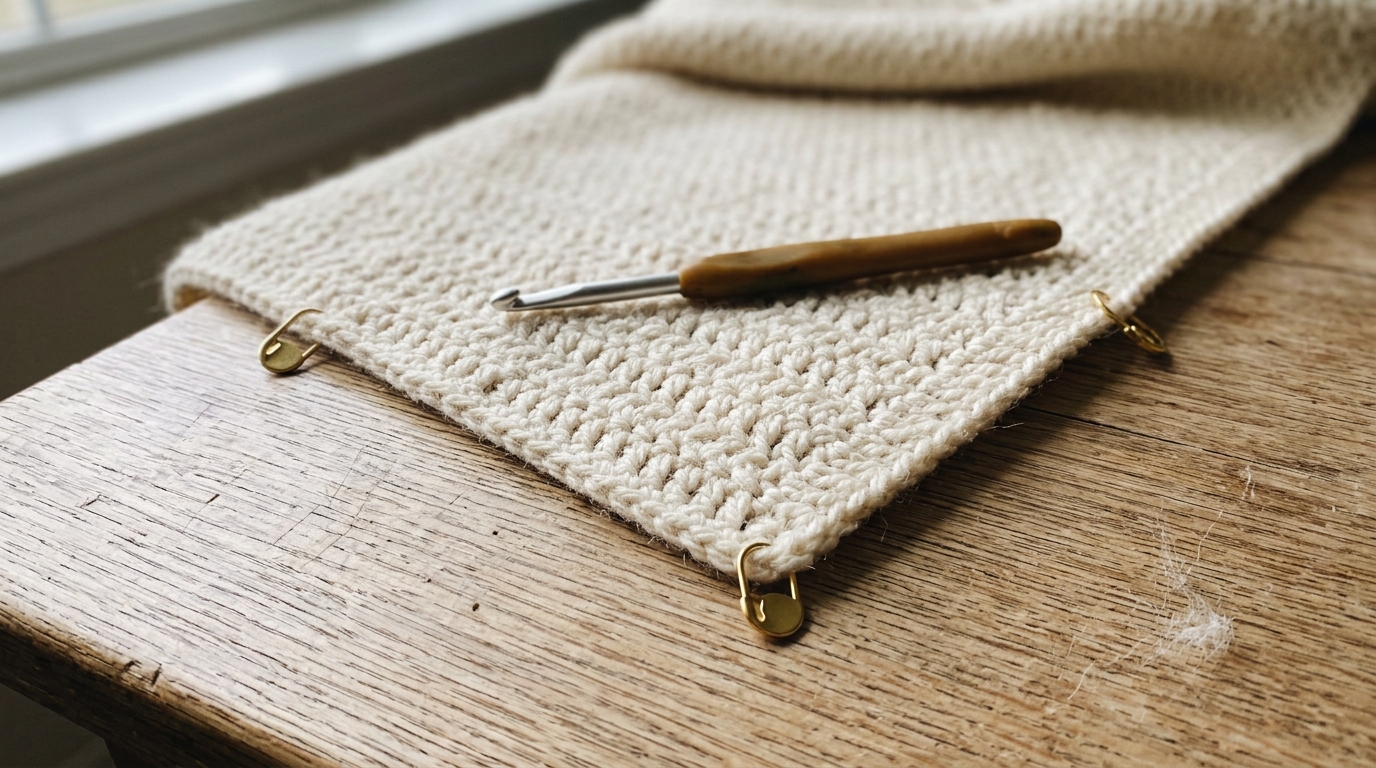
Quick answer. Start with worsted weight yarn and a 5.5 mm (I/9) hook, work double crochet rather than single crochet, and keep the blanket somewhere around 30 to 38 inches wide. Count your stitches at the end of every row. Almost every crooked first blanket comes from one thing: the turning chain at the start of the row, counted as a stitch in some rows and not in others.
The first blanket usually goes wrong in the same two ways. One side slowly creeps in or flares out, and the yarn runs out with a foot of blanket still to go. Neither is a skill problem. Both are counting problems, and both are fixable before you make the first chain.
The turning chain is what makes your edges go crooked
At the start of every row you make a short chain to lift the yarn to the height of the stitch you are about to work. Whether that chain is a stitch depends on which stitch you are using, and patterns do not always spell it out.
The rule that fixes most crooked edges: if the turning chain counts as a stitch, it is always the first stitch of the row. For single crochet, it does not count. For double crochet, the three chains usually do. That single difference decides where your last stitch of the row goes, because the last stitch of the row goes into the top of the turning chain from the row below.
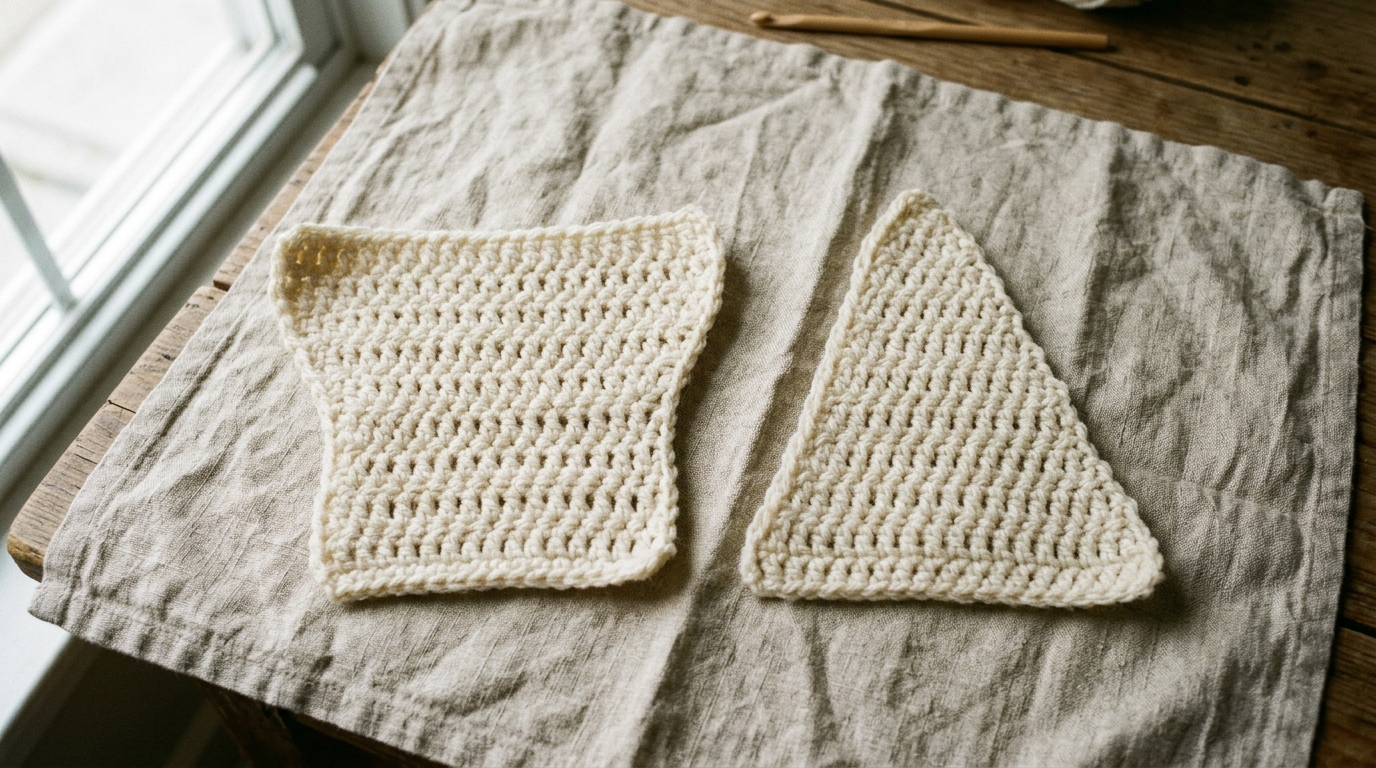
Get it wrong in one direction and you add a stitch every row, and the blanket flares. Get it wrong in the other and you lose one, and the blanket narrows to a wedge. As B.Hooked puts it, if you make one stitch too many or too few in a row, you will see it in your edges.
 Pin it
The fix takes ten seconds per row. Count your stitches at the end of every row while you are learning, and put a stitch marker in the first and last stitch of the row. A blanket that drifts by one stitch every row is off by fifty stitches by the time you notice it, and there is no way to correct that except by pulling back.
Double crochet is the better first blanket stitch, and not only because it is faster
Single crochet, double crochet and half double crochet are all reasonable beginner stitches. For a whole blanket, double crochet is the one to pick. It works up more quickly, which matters over several thousand stitches, and it gives a softer fabric. Single crochet on a blanket comes out stiff unless you compensate, and the standard advice if you insist on single crochet is to go up at least two hook sizes from what the yarn label recommends.
Taller stitches also make your counting easier. Double crochet posts are visible from a distance, so a missed stitch shows up in the row you made it rather than four rows later.
Nobody can tell you how many skeins to buy
This is the part that surprises people, and it is worth knowing before you stand in front of a yarn wall.
Take one size, a 50 by 60 inch throw in worsted weight, and read what the published yardage guides say. Three of them give three different answers: one puts it at 1,000 to 1,200 yards, another at 2,000 to 3,000 yards, and a third gives it as 6 to 12 skeins without fixing what a skein holds. The top of that range is nearly three times the bottom. They are all describing the same blanket.
They are not wrong. They are estimating different things. One brand’s skein may hold 200 yards while another holds 100 yards at the same yarn weight, which is why yardage is the useful number and skein count is not. On top of that, lacy stitches eat more yarn and dense stitches use slightly less, so your stitch pattern moves the total before your tension does.
So the honest answer to “how much yarn” is that the charts give you a starting bracket, and your own swatch gives you the number. Work a swatch in the stitch you are actually going to use, measure the middle four inches of it vertically and horizontally, and buy against that. Then buy one ball more than you calculated, from the same dye lot, because colours vary slightly between batches and because a spare ball covers a change in tension, a pattern adjustment, or an edging you decide on later.
Sizes that finish
The usual finished dimensions look like this:
| Blanket | Finished size | Worsted weight |
|---|---|---|
| Baby blanket | 30 x 40 to 36 x 48 in | 2 to 3 skeins |
| Lapghan | 36 x 48 to 40 x 60 in | 6 to 9 skeins |
| Throw | 50 x 60 to 54 x 72 in | 6 to 12 skeins |
For a first blanket, aim smaller than the throw: roughly 30 to 38 inches wide by 38 to 46 inches tall. That is large enough to be a real blanket and small enough that the mistakes you make in the first ten rows do not cost you a month.
How to set the starting chain so row one is not a guess
1. Compare the yarn label with the pattern
Check the yarn label for its recommended hook size, and compare it against what your pattern asks for. If they disagree, the pattern wins, because the pattern was written to a gauge.
2. Work a swatch at least five inches square
Use the stitch you are actually going to use for the blanket, not whichever one is quicker to swatch. A lacy stitch and a dense stitch give different numbers from the same yarn and the same hook.
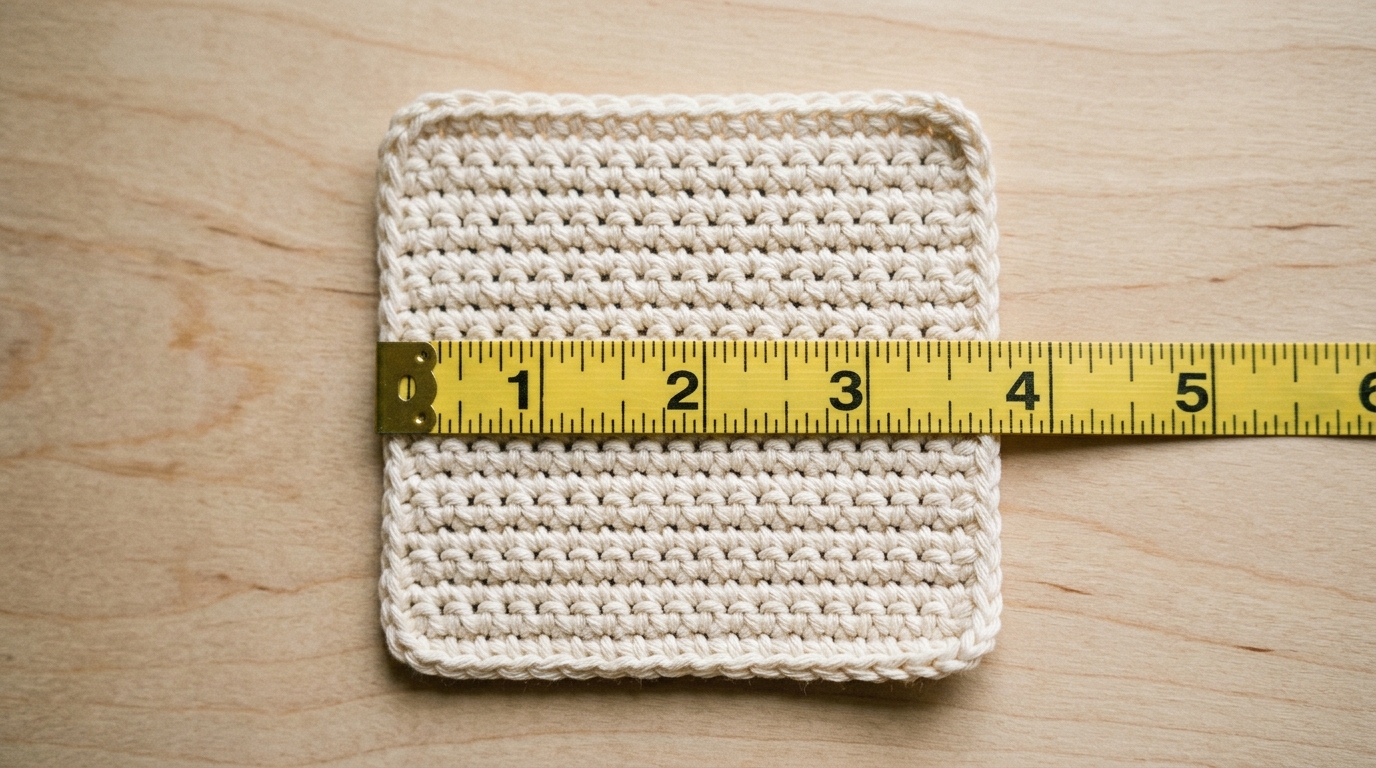
3. Measure the centre four inches, across and down
Count the stitches and rows inside that square. The edges of a swatch curl and lie, the middle does not.
 Pin it
4. Change hook size if the count is off
If you have too many stitches in four inches, work the swatch again with a larger hook. Too few, go smaller. This is the only part of the process that costs you an evening, and it is the part that decides the finished width.
5. Divide your target width by the stitches per inch
That is your foundation chain, plus whatever the pattern adds for the turning chain.
Worked through with real numbers: say your swatch gives 12 double crochet across four inches, so 3 stitches per inch, and you want a 36 inch blanket. That is 108 stitches, plus 3 chains for the turn. Chain 111. If your swatch had come out at 14 stitches across four inches instead, the same 36 inches would need 126 stitches, and starting from 111 would have left you a blanket five inches too narrow.
The swatch feels like a waste of an evening. It is the difference between a blanket that ends up the width you planned and one that ends up eight inches narrower with no yarn left to fix it.
What this approach is not good for
If what you want is a finished blanket this weekend, this is the wrong route. A worsted weight blanket at these sizes runs to about a week of steady evenings, and that assumes you are not unpicking rows. If the deadline is real, use a super bulky yarn instead, category 6, with the hook sized to match. That is the route in the chunky yarn blanket guide, and the four hand methods take it further still, with no hook at all. It is a coarser fabric and it will not look like the fine granny squares that sent you looking in the first place, but it finishes.
This guide is also not a pattern. It gives you the decisions that sit underneath every beginner blanket pattern, so that when a pattern says “ch 3, turn” you know whether that chain is a stitch. Take it to any beginner blanket pattern you already have open and it will read differently. If you would rather practise the turning chain on something that finishes in an evening first, these four small projects teach the same counting on twenty stitches instead of a hundred.
Questions people ask before starting
Why is my blanket wider at the top than at the bottom?
You are adding a stitch at the start of rows. If your turning chain counts as a stitch, you are not meant to also work into the base of it. Doing both puts an extra stitch in every row.
Why is my blanket narrowing instead?
The mirror image of the same fault. If the turning chain does not count as a stitch, you are meant to work into the base of it. Skipping it loses one stitch a row.
Can I use single crochet for my first blanket?
You can, but go up at least two hook sizes from the label recommendation, otherwise the fabric comes out stiff. Expect it to take considerably longer than the same blanket in double crochet.
Do I really need a gauge swatch for a blanket?
For a blanket, more than for anything else. Nothing has to fit, so people skip it, and then the finished width is wrong by several inches and the yarn total is wrong along with it. The swatch is what turns the yardage bracket into a number.
How many skeins should I buy?
Work out yards, not skeins, then check how many yards are in the ball you are actually buying. Add one extra ball from the same dye lot.
The same exact-yardage approach works for a project with a fixed area, worked out in how to make a chunky yarn pillow.
The same fixed-area yardage math also explains why chunky yarn pillow covers come out exact while a full blanket rarely does, and why DIY crochet throw blankets need the same yardage check before starting.