Quick answer. A 50 by 60 inch throw takes about 4 balls of Bernat Blanket, which is around 804 metres. The same size is asked for as 1 ball by one free pattern and 9 by another, so treat 4 as the middle of a range, not a promise. One ball is 300 g and 220 yards, or 201 metres. Work out your size in square feet, multiply by 0.18, round up, and buy one spare ball from the same dye lot.
You found a pattern you like, it says “6 balls”, and you are standing in the aisle wondering if that is enough for your couch.
I have been in that aisle. The pattern page gives you one number and no reason for it.
A pattern that prints its own size chart, like the Jaske throw, is the easiest place to check a count against. This guide gives you the reason.
It covers how many balls each common blanket size takes, how many metres are in one ball, why two patterns for the same size disagree, and how to work out your own count in four steps.
How many balls of Bernat Blanket does a 50 by 60 throw take?
Across the 51 free patterns written for a throw close to 50 by 60 inches, the ball count runs from 1 to 9. The middle is 4.
Half of the patterns sit between 3 and 5 balls, with 13 asking for 3 and 13 asking for 4.
Across all 66 patterns in the Bernat Blanket family that state a finished size, the median is 0.18 balls for every square foot of blanket.
On a 50 by 60 throw that comes to about 3.7 balls, which you round up to 4.
Here is that figure turned into a chart you can use in the shop. Each row is the 0.18 figure multiplied by the area, rounded up to a whole ball. Metres are simply balls multiplied by 201.
| Blanket size | Area (sq ft) | Balls | Metres |
|---|---|---|---|
| 30 by 36 in (76 by 91 cm) | 7.5 | 2 | 402 |
| 36 by 48 in (91 by 122 cm) | 12 | 3 | 603 |
| 50 by 60 in (127 by 152 cm) | 20.8 | 4 | 804 |
| 60 by 72 in (152 by 183 cm) | 30 | 6 | 1206 |
| 66 by 90 in (168 by 229 cm) | 41.25 | 8 | 1608 |
Read the table as a starting point, and check it against the size chart in your pattern if it has one, as the Jaske throw pattern does.
It tells you what a typical pattern asks for. The pattern you actually choose can land a ball or two either side, and the rest of this guide explains why.
How many metres are in one ball of Bernat Blanket?
One ball of Bernat Blanket weighs 300 g and holds 220 yards. That is 201 metres. Every metre figure in this guide comes from that one number.
A smaller ball sits on the same shelf and looks similar. Bernat Blanket Extra holds 97 yards, which is 89 metres.
If a pattern says “6 balls” and does not say which yarn, you cannot tell whether it means a little under 1206 metres or something close to half that.
The word “super bulky” will not rescue you either.
Among thick yarns sold in the same weight category 6, the yardage in 100 g runs from 16 yards to 109 yards.
That is a sevenfold gap inside one label, so the ball band in your hand beats any chart, including mine.
A material list that names the yarn, such as the one in the Jaske throw file, saves you the guessing.
- Read the yardage on the band you are holding, not the weight alone.
- Multiply balls by yards per ball and you have the total yards.
- For the standard ball, use 201 metres and you can skip the conversion.
What free Bernat Blanket patterns actually ask for
Here is the thing nobody says on the pattern page. The ball count is a property of the pattern, not of the blanket size.
Two designers can both draw a 50 by 60 throw and hand you different shopping lists, because they used different stitches.
That is why the spread is so wide. A lacy, open stitch eats fewer balls than a dense one. A dense stitch packs more yarn into every square inch, so the same area takes more balls. The Bernat Blanket yarn waffle stitch is the clearest case: those raised squares are built from post stitches worked over two rows, and they drink yarn next to a plain granny row.
A pattern made of only double crochet, single crochet and chain stitches, like French Countryside, is easier to reason about for exactly this reason.
A yardage count on worsted yarn gives you a useful contrast.
Inside one stitch pattern, use stays steady: granny stitch runs from 0.89 to 0.98 yards per square inch across ten sizes, and mini bean from 1.25 to 1.40.
Between the two stitches the gap is about 40%. So once you know which stitch you are using, the count for other sizes is easy to scale.
Switching stitch is what throws your count off.
Patterns also tell you very little about how long they take.
Not one of 23 blanket patterns named a making time, so when you read “works up in a weekend” on a product page, it is a guess about somebody else’s hands.
Bernat Blanket, Blanket Extra or Blanket Big for a throw
The three lines are different yarns, and the count you read for one does not transfer to another.
- Bernat Blanket: the standard ball, 300 g and 220 yards. The chart above is written for this one, so you can read it as printed.
- Bernat Blanket Extra: the smaller ball, 97 yards or 89 metres. The median for the same area is higher, 0.225 balls per square foot, which is about 4.7 balls on a 50 by 60 throw.
- Bernat Blanket Big: the sample is thin. One pattern asks for 3 balls at 49 by 52 inches, one for 8 at 50 by 60 and one for 7 at 48 by 72. The ball yardage is not confirmed here, so I will not give you a metre figure for it.
If a pattern you love, such as French Countryside, names another line, use its count as written and do not borrow numbers from the chart.
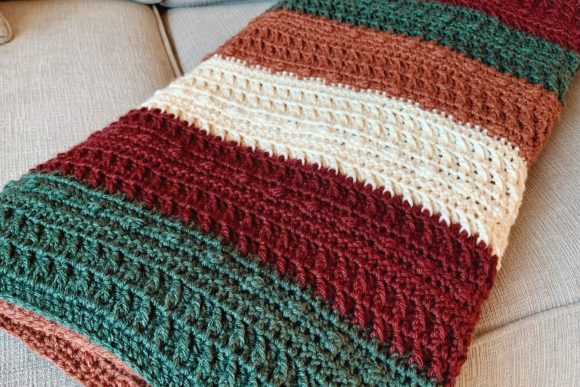
For a plain stripe layout, the tartan one is worked in one piece, which keeps the count predictable.
The thick yarn is also the reason you finish this kind of project quickly.
The large knitted blanket guide shows what the same 60 by 72 inch size costs you in stitches when the yarn is thinner, and the numbers explain why super bulky is the speed pick.
How many balls for a baby blanket in Bernat Blanket
A 30 by 36 inch baby blanket is 7.5 square feet. Multiply by 0.18 and you get 1.35, which rounds up to 2 balls, or 402 metres.
Two balls leaves you very little room. If you are working a dense stitch, or you like a blanket that hangs over the edge of a cot, buy 3.
A baby blanket is the size where one extra ball is the largest share of the total, and the one where running short annoys you most, because the last row is a border.
For a baby size, the tartan pattern scales down well. For an easy first baby project before you commit, the small starter projects guide lets you practise tension on twenty stitches first.
How many balls for a bed-size blanket in Bernat Blanket
A 66 by 90 inch blanket is 41.25 square feet. At 0.18 balls per square foot that is 7.4, so you round up to 8 balls, or 1608 metres.
If your bed is smaller, a 60 by 72 inch size sits below it at 6 balls and 1206 metres.
At this size the spread between patterns matters most to you, because every ball of difference is a large purchase.
If your pattern gives a ball count for a size, trust the pattern over my chart. If it gives no count at all, use the chart and add a spare.
A pattern with a size chart for larger sizes, like the Jaske throw, gives you a designer’s count to compare with mine.
Buy every ball for a bed blanket in one go. You will work for many evenings, and a mismatch in dye lot shows most on a large, plain surface.
Which hook or needles fit Bernat Blanket

For crochet, a 9 mm or 10 mm hook is the usual pick for this yarn. Half double crochet and chevron ripples show off the thick texture well, which is why so many free patterns use them.
For knitting, choose circular needles in US size 11 or larger.
A full-size blanket is heavy, and a pattern that lists the hook for you, as the Jaske throw does with a 6 mm hook for its medium yarn, removes one guess.
A circular needle also lets the weight rest in your lap instead of pulling on your wrists.
- Test a small square before you buy the full quantity.
- If the fabric feels stiff, go up a hook size. If it looks open and floppy, go down.
- Stick to the stitch the ball count was written for. Changing stitch changes your count.
If you are new to hooks, the beginner blanket guide covers how to swatch before you commit yarn.
Why the same size can take a different number of balls
When two patterns for the same size disagree, four things are usually behind it.
- The stitch. Dense stitches take more yarn than lacy ones. This is the largest factor.
- Your tension. A tighter hand packs more yarn into every inch.
- The border. Some designers count it in the total, some add it after.
- The ball. A pattern written for the small ball gives a count that looks high next to one written for the big ball.
The fourth is the trap. French Countryside is a pattern where the stitches stay the same from body to border, so the count stays stable.
A number in a pattern is only meaningful next to the yarn it names. Check that it names the same line you are holding before you compare two counts.
“A ball count is a stitch count in disguise: it tells you how much yarn one designer’s stitches needed, not how much yarn a size needs.”
How to work out your own ball count in four steps
1. Turn your size into square feet
Multiply your width by your length in inches, then divide by 144. A 50 by 60 throw is 20.8 square feet.
2. Multiply by 0.18
That is the median for Bernat Blanket in the standard ball. If you are holding Blanket Extra, use 0.225 instead.
3. Round up to a whole ball
If you get 3.7, buy 4. Never round down, because you cannot buy half a ball.
4. Add one spare and check the band
Read the yardage on the ball you are holding. If it says 220 yards, the chart holds. If not, recalculate with the number on your band.
How many spare balls to buy and why dye lot matters
Buy one spare ball for any blanket, including one worked from the tartan pattern.
I would make it two for the bed size, where the cost of a stray ball is lowest compared with the risk of running short in the last evening.
The reason to buy everything at once is the dye lot. Colour is mixed in batches, and a ball bought later can come from a different batch.
On a plain, thick blanket the change shows as a band across the fabric, and once it is worked in you cannot hide it.
When a ball does run out mid-row, do not knot it. Lay the old tail and the new tail alongside each other for the last few stitches, work them together as one strand, then carry on with the new ball alone and weave both tails into the back later.
On a chenille strand a knot sits up as a lump you can feel through the blanket, so the overlap is worth the extra minute.
- Check the lot number printed on each band you pick up.
- Buy all the balls in one shop visit if you can.
- Keep your spare ball sealed until the end.
Which Bernat Blanket colour lines count the same
Patterns list the yarn by colour and by effect. The effect lines include Perfect Phasing, Sparkle, Ethereal Stripes, Pixel, Confetti, Speckle and Tweeds, and each appears in patterns the same way a solid colour does.
I cannot tell you from a pattern page that every one of those balls holds 220 yards, and neither can the pattern.
A pattern such as French Countryside names its yarn weight, which is the line to check. So the rule is the same as for the size: read the band.
If an effect line gives the same 220 yards as the solid, the chart above holds. If it gives a different number, recalculate with that number.
One more tip. When you mix a solid and an effect line in one blanket, count each line separately, with its own ball yardage, and keep a spare of each.
Patterns written for a throw, sized and ready
Once you know how many balls you need, the last question is which pattern to work.
A paid pattern earns its place when it gives you the thing a free page skips: a size chart, stitch counts and a material list in one file.
These three are written for throw-size blankets and come as downloads you can print.
Unlimited creative assets. Access to AI tools.
Commercial licence included.

The Jaske Throw Blanket
A textured throw with a simple repeat, written with a size chart for larger blankets and a material list. Finished size is 48 by 56 inches.

French Countryside Blanket
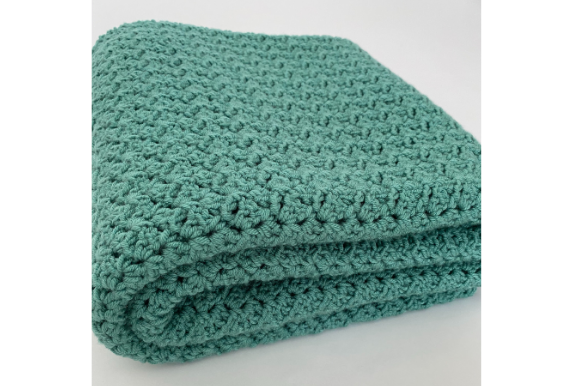
Only double crochet, single crochet and chain stitches, with a border that repeats the body stitch. A good pick if you want texture without a hard learning curve.
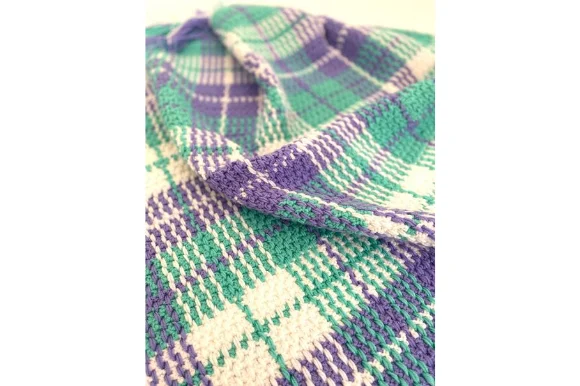
Tartan Crochet Blanket Pattern
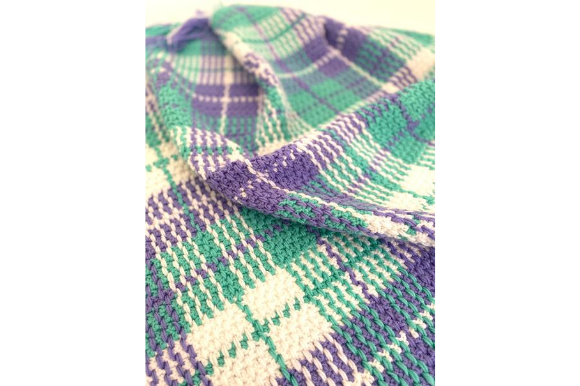
The look of squares from a blanket worked in one piece, with yarn ends that become the tassels. Easy enough for a first large blanket.
If you would rather go chunkier, the chunky Bernat guide counts in yards instead of balls, the jumbo yarn guide covers the no-hook version, the by-hand guide shows a blanket made without tools, and the crochet throw guide walks through a full throw.

Questions about Bernat Blanket balls
How many Bernat Blanket balls do I need for a throw blanket?
About 4 balls for a 50 by 60 inch throw, which is around 804 metres. Free patterns for that size ask for anywhere from 1 to 9, so check the count in your own pattern.
How much Bernat Blanket yarn do I need?
Multiply your blanket area in square feet by 0.18 and round up to a whole ball. A 66 by 90 inch blanket comes to 8 balls, or 1608 metres.
What size is Bernat Blanket yarn?
The standard ball weighs 300 g and holds 220 yards, or 201 metres. It is a super bulky yarn in weight category 6.
What size crochet hook or knitting needles work best with Bernat Blanket yarn?
A 9 mm or 10 mm hook for crochet. For knitting, circular needles in US size 11 or larger.
What can I make with Bernat Blanket yarn?
Throws, baby blankets and bed-size blankets are the usual projects, such as this throw pattern, worked in stitches such as half double crochet or chevron ripples. The thick strand is what makes a blanket quick to finish.
Is Bernat Blanket yarn discontinued?
I have no stock notice to quote, and a pattern page will not tell you.
What I can say is that the maker’s free pattern catalogue for it still runs to thousands of patterns.
Ask your shop whether your colour is in stock before you plan the blanket.
What is the difference between Bernat Blanket yarn and Bernat Baby Blanket yarn?
They are different yarns with different ball bands, and the chart in this guide is written only for Bernat Blanket in the 300 g ball.
For Baby Blanket, read the yardage on its band and recalculate with the 0.18 step from the four steps above.
Is there a difference between Bernat Blanket yarn and Bernat Baby Blanket yarn?
Yes, in the ball. Do not reuse a ball count written for one on the other.
Where can I download free baby blanket knitting patterns?
The maker’s own catalogue is the place to start. For a 30 by 36 inch baby blanket you need about 2 balls, worked on circular needles in US size 11 or larger.
Is Bernat Blanket Extra the same ball as Bernat Blanket?
No. Blanket Extra holds 97 yards, or 89 metres, against 220 yards in the standard ball. The count for one does not carry over to the other. For a first throw pattern, French Countryside is an easy pick.