Quick answer. One C2C waffle stitch square is about 1.76 cm wide and 1.82 cm tall in DK yarn on a 4.5 mm hook, so a 130 cm wide crochet blanket is 74 squares across. Change the hook and the square changes with it: the same 55 square chart comes out 97 cm wide on a 4.5 mm hook and 129 cm on a 6 mm one.
Gauge is the number you check before you start, and it is the one number a waffle tutorial almost never gives you in centimetres.
You can learn the stitch in ten minutes, follow a chart square for square, and still finish a blanket a hand narrower than the pattern promised you.
Asked the same question on the same day, two AI answers disagreed outright. One gave a firm 17 stitches by 11 rows over 10 cm in DK yarn on a 4.5 mm hook.
The other said there is no universal waffle gauge at all, and that a straight row swatch must never be carried over into corner to corner.
Neither of them told you how wide one waffle square is, which is the only figure that turns a chart into a finished size. I have put that figure below, with what it does to four blanket sizes and five hooks.
Squares across = width in cm / width of one waffle square. Rows = squares across + squares down – 1.
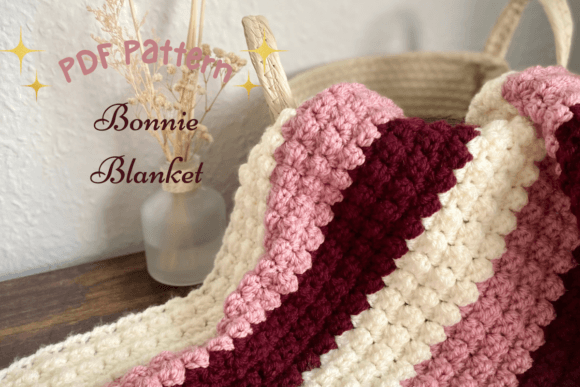
If you would rather not do the sums, a written file such as the Bonnie baby blanket prints its gauge and its finished sizes in the pattern itself. For the stitch mechanics on their own, the corner to corner guide covers the increase and decrease rows, and the C2C stitches compared shows where the waffle sits next to moss and granny.
C2C waffle stitch crochet blanket: the gauge to check before you start
The waffle is a two row repeat. One row is plain double crochet, and on the next you drop a front post double crochet into the post of the stitch below.
The raised ridges that cross between them make the waffle cells. In straight rows your count is a multiple of three plus two, because each cell takes three stitches across.
In corner to corner none of that is what you count. You count squares, and each square is its own small block of three stitches and a chain.
The question stops being how many stitches and becomes how wide is one of your squares, which is the question the tutorials skip.
Three things move that square: your yarn weight, your hook, and how hard you pull the post stitches.
The posts are the reason the waffle runs tighter than plain double crochet in the same yarn, and I find tension on them varies more between two crocheters than on almost any other stitch.
So your gauge comes before the chart, not after it. You pick the size you want, measure your own square, divide, and only then count the increase rows. The ready made files in the C2C pattern section do that division for you and print the result.
How to make a C2C waffle stitch gauge swatch when the rows run diagonally
A normal gauge square is 10 cm of flat fabric with the rows running side to side. In C2C your rows run corner to corner, so you have no flat 10 cm until the increase rows have built one.
- Work your increases until the straight edge of the triangle is about 15 cm, which gives you a flat section to measure inside.
- Lay the swatch down without stretching it and count the squares along one straight edge.
- Measure that edge in centimetres and divide by the squares you counted. That is your square width.
- Measure the other edge the same way: the waffle square is taller than it is wide, so your two readings will not match.
- Wash and dry the swatch the way you will wash the blanket, then measure again and keep the second reading.
Measure ten squares rather than five if you can. A misread centimetre spread over ten squares costs you half what it costs over five, and on a throw of 74 squares that error is multiplied every time.
Keep the swatch: when your blanket comes out narrow six weeks later, it tells you whether the yarn moved or your counting did.
A file like Mikeisha’s baby blanket gives you a second set of numbers to measure yours against, and the stitches for blankets guide shows how wide the other common stitches run.
One waffle square in centimetres, and the width it gives you
Take that firm gauge of 17 stitches and 11 rows over 10 cm in DK on a 4.5 mm hook. A waffle cell is three stitches across and two rows tall, so one cell is 10 x 3 / 17 = 1.76 cm wide and 10 x 2 / 11 = 1.82 cm tall.
Your cell is three per cent taller than it is wide, which is why a blanket that is square in squares is never square in centimetres.
From there it is one division. Below are four finished sizes at three hooks, with the squares across by squares down and the diagonal row count.
| Finished size | 4.5 mm hook | 6 mm hook | 7 mm hook |
|---|---|---|---|
| 75 by 90 cm (pram) | 42 by 51, 92 rows | 32 by 38, 69 rows | 27 by 33, 59 rows |
| 100 by 130 cm (lap) | 57 by 74, 130 rows | 42 by 55, 96 rows | 36 by 47, 82 rows |
| 130 by 150 cm (throw) | 74 by 85, 158 rows | 55 by 64, 118 rows | 47 by 55, 101 rows |
| 170 by 230 cm (twin bed) | 96 by 130, 225 rows | 72 by 98, 169 rows | 62 by 84, 145 rows |
Read one row across and you are looking at the same blanket as three different projects. The throw is 6290 squares on the small hook and 2585 on the large one, which is 2.4 times the work for an identical finished size.
A waffle chart never tells you how long it will take you. Your square width does, and that is the figure I would hold on to.
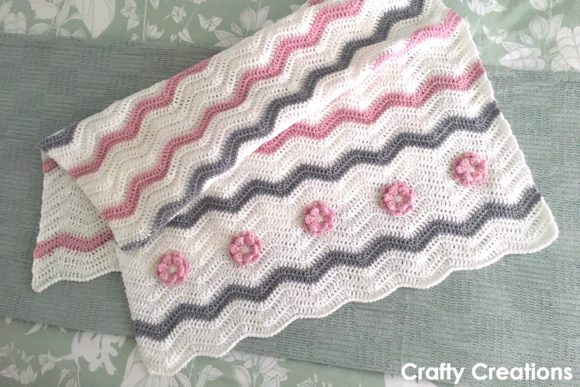
If you would sooner read the sizes than work them out, the Bonnie pattern includes a size chart of five sizes from receiving blanket to single bed, and the Floral Ripple blanket states its finished size as 120 by 85 cm.
For the plain version of this table, the C2C size chart in centimetres runs the same sums without the waffle, and the C2C baby blanket in centimetres works one size right through.
Why one AI answer says 17 by 11 and the other says there is no gauge
The firm number comes from one pattern writer’s own swatch. It is a straight row waffle in DK on a 4.5 mm hook, and inside that pattern it is correct.
Quoted on its own it reads as a property of the stitch, which it is not, and you can lose a blanket to that.
The flat refusal comes from looking at many patterns at once. Across free waffle patterns the hook for a medium weight yarn runs from 4.5 mm to 6 mm, and the posts take tension differently in every pair of hands, so no single pair of numbers covers them all.
My reading is this. Use a published gauge as a starting hook, not as your gauge, and never carry a straight row waffle gauge into a corner to corner chart.
The straight row count is a multiple of three plus two across; your C2C count is squares on a diagonal, built at a different angle with different tension on the posts.
Which leaves one number that has to come from you: the width of your own square. A paid file removes the guess by naming the yarn and hook it belongs to, which is all a written waffle pattern really sells you.
Twenty-four C2C waffle blanket ideas with the square size each one needs
Each idea names the finished size and the squares across you need. Pram and lap sizes use the 4.5 mm column, throws and bed sizes the 6 mm one, so your counts stay sensible to work.
1. Plain pram blanket in one colour
75 by 90 cm, 42 squares across. The quietest version of the stitch, and the best place for you to learn where the posts sit.
2. Two colour diagonal split pram blanket
75 by 90 cm, 42 across, with your colour change on the diagonal at square 21. The waffle hides the carry better than plain double crochet does.
3. Waffle pram blanket with a solid border
70 by 85 cm of waffle, 40 across, plus 3 cm of double crochet all round to bring you to size.
4. Newborn receiving square
60 by 60 cm, 34 across. A square in squares comes out 1 cm taller than wide, and nobody notices on a piece this small.
5. Car seat cover blanket
65 by 80 cm, 37 across. Short enough not to trail under the wheels.
6. Striped waffle pram blanket
75 by 90 cm, 42 across, your colour changed every six rows. Each stripe lands as a wedge, not a band, because the rows run diagonally.
7. Lap blanket for a chair
100 by 130 cm, 57 across on a 4.5 mm hook or 42 on a 6 mm one. The second version saves you 1850 squares.
8. Waffle lapghan with pockets
100 by 130 cm, 42 across on a 6 mm hook, with two patch pockets worked flat in the same stitch. If you want the shaping written out, a lapghan file gives you the counts.
9. Gradient lap blanket in four shades
100 by 130 cm, 42 across, changing shade every 24 rows. The texture reads a gradient softly.
10. Sofa throw in a bulky yarn
130 by 150 cm, 47 across on a 7 mm hook. At 101 rows it is the fastest full size waffle you will find here.
11. Classic worsted throw
130 by 150 cm, 55 across on a 6 mm hook, 118 rows. The default throw, and the one most charts you meet are written for.
12. Throw with a waffle centre and plain edges
Waffle to 110 by 130 cm, 47 across, then 10 cm of plain double crochet to reach 130 by 150 cm.
13. Two tone chequerboard throw
130 by 150 cm, 55 across, your colours swapped in blocks of eight squares.
14. Single bed blanket
170 by 230 cm, 72 across on a 6 mm hook, 169 rows. I would plan this one in sections of 20 rows.
15. Double bed waffle blanket
200 by 230 cm, 85 across on a 6 mm hook. Your square count passes 8000, so a bulky yarn is kinder here.
16. Waffle blanket with a crochet ribbon tie
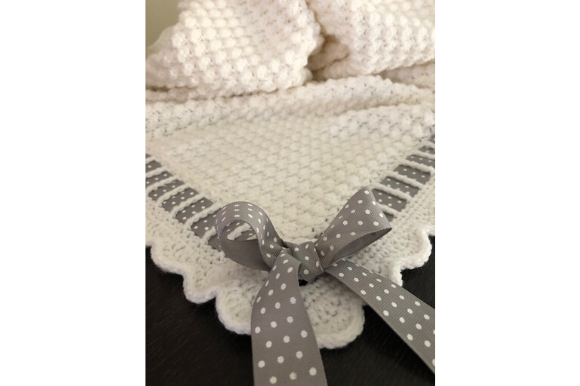
90 by 110 cm, 38 across on a 6 mm hook, finished with a chain tie so it rolls into a gift. Mikeisha’s blanket uses a ribbon the same way.
17. Cot blanket to fit the mattress
70 by 120 cm, 40 across. Length matters more than width in a cot, so measure your mattress first.
18. Waffle blanket for a floor mat
90 by 90 cm, 51 across on a 4.5 mm hook. The tighter gauge gives you the thickness a mat needs.
19. Waffle pet blanket
60 by 80 cm, 26 across on a 6 mm hook. Small enough to wash often.
20. Picnic blanket with a dense gauge
130 by 170 cm, 55 across, worked one hook size down from your label for a firmer fabric.
21. Waffle blanket and matching cushion
Throw at 55 across, cushion front at 45 by 45 cm and 19 across in the same yarn. Your cushion is the leftover skein.
22. Granny square border on a waffle centre
Waffle centre 100 by 120 cm, 43 across, framed with granny squares.
23. Waffle blanket with an appliqué panel
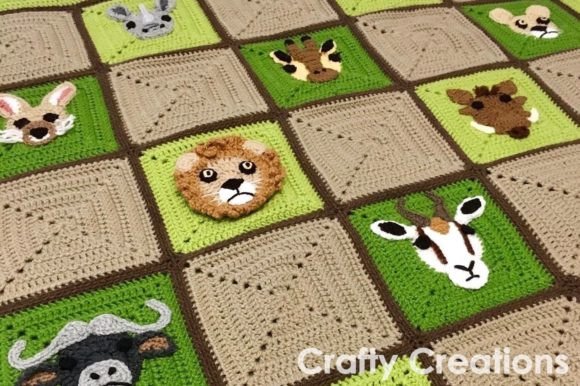
100 by 130 cm, 42 across, with a flower or animal panel sewn on after blocking, the way the South African Safari blanket does at 160 by 120 cm.
24. Scrap yarn waffle throw
130 by 150 cm, 55 across, one shade per 10 rows, using whatever you have left of the same weight. Keep to one yarn weight or your square width moves mid blanket.
If the blanket is a gift and has to come out the size you promised, I would start from a written file. Mikeisha’s baby blanket is written for a cot sized piece, and the baby blanket patterns guide lists finished sizes that fit a cot.
The waffle pulls in: how many centimetres you lose against plain double crochet
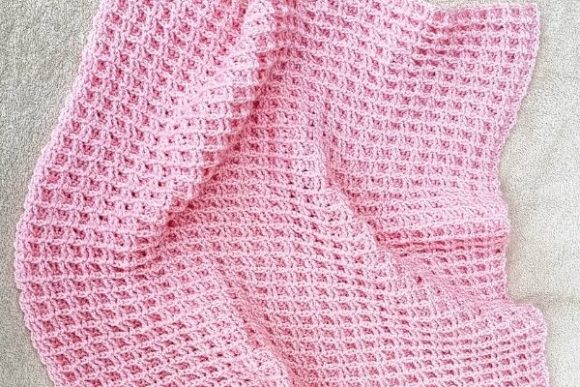
The posts wrap around the stitch below instead of into the top of it, and that pulls your fabric together both ways. The same stitch count in waffle is narrower than in plain double crochet, and you measure the difference in inches across a blanket, not in millimetres.
The sharpest way to see it is to hold the squares still and move the hook. On a chart of 55 squares across, written for a 6 mm hook and meant to finish at 130 cm, here is what you get:
- 6 mm hook: 129 cm. One centimetre under, which nobody will see.
- 5.5 mm hook: 119 cm. Eleven centimetres under.
- 5 mm hook: 108 cm. Twenty two centimetres under, which is a different blanket.
- 4.5 mm hook: 97 cm. Thirty three centimetres under, a lap blanket where you planned a throw.
Half a hook size looks like nothing and costs you eleven centimetres.
The fix is not to add rows at the end, because rows on the diagonal make your blanket longer as well as wider.
You either get the square right first, or you plan a border that brings the width back. The blanket border guide has the counts that keep that edge flat, and a C2C file with its gauge printed saves you the argument.
Hook sizes for DK, worsted and bulky, and what happens one size down
Published waffle patterns for a medium weight yarn use anything from 4.5 mm to 6 mm, and the advice you meet most often is to go up one or two sizes from your yarn label, because the stitch is tight on its own.
Here is what each hook does to the square and to a 130 cm throw.
| Hook | Square width | Squares across for 130 cm | Diagonal rows, 130 by 150 throw | What I would use it for |
|---|---|---|---|---|
| 4.5 mm | 1.76 cm | 74 squares | 158 rows | DK, and only at pram size. Firm, dense and slow, good for a floor mat. |
| 5 mm | 1.96 cm | 66 squares | 141 rows | DK when you want drape. My default if the label says 4.5 mm. |
| 5.5 mm | 2.16 cm | 60 squares | 129 rows | DK or a light worsted. The most forgiving middle on tension. |
| 6 mm | 2.35 cm | 55 squares | 118 rows | Worsted, and the hook most C2C waffle charts assume. Where I start a throw. |
| 7 mm | 2.75 cm | 47 squares | 101 rows | Bulky, for a bed sized blanket you want finished this season. |
One size down from the chart is not a small change. It takes a 55 square throw from 129 cm to 119 cm, and two sizes down takes you to 108 cm.
Going up is the safer mistake.
A square that is too wide you fix by working fewer squares, which costs you a recount and nothing else, while a square that is too narrow you fix by frogging or by a wide border. The Floral Ripple file names its hook, so you can see which end of that range it sits at.
How much yarn does a C2C waffle blanket use?
More than the plain version of the same blanket, and the posts are the reason. Each front post double crochet travels down and around the stitch below, so it eats more yarn than a double crochet worked into the top.
Count in squares rather than in metres and your estimate gets easier. A 130 by 150 cm throw is 6290 squares on a 4.5 mm hook and 3520 on a 6 mm one, and each waffle square costs roughly a fifth more yarn than the same square in plain C2C.
So my rule is to buy for the plain blanket and add a skein. Keep to one yarn weight across the whole blanket, because a change part way through moves your square width.
The metres of yarn by bed size guide has the plain figures you start from, the skeins per size guide counts them in balls, and the Safari blanket lists its yarn by colour for a 160 by 120 cm piece.
Texture and drape: six fixes when the fabric comes out stiff
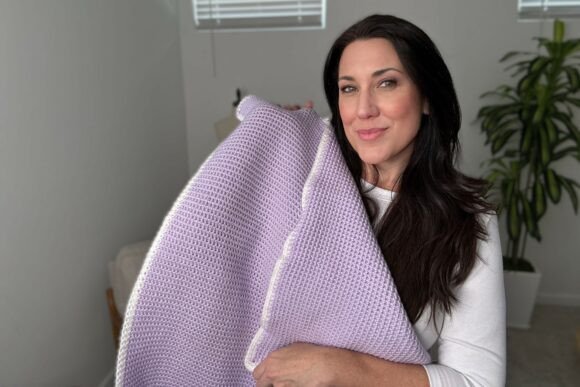
A stiff waffle is the commonest complaint after a narrow one, and it has six cures.
- Go up a hook size. Your fastest fix, and it loosens both the posts and the squares.
- Loosen the posts on purpose. Pull the loop a touch longer as it comes round the post rather than snugging it in.
- Change the yarn, not the stitch. A soft spun acrylic or a cotton blend drapes where a tightly plied yarn will not.
- Block it. Wet blocking opens the fabric and relaxes the ridges, and on a waffle I think it is worth the trouble.
- Keep the blanket smaller. A dense waffle works at pram or lap size and reads as armour at bed size.
- Soften the edges. A plain double crochet border round a waffle centre lets your fabric fall at the sides.
Stiffness is not a fault in the stitch. The waffle is thick because it has two layers of ridges, and that is why you would use it for a floor mat and loosen it for a throw. A textured blanket file will name the yarn it drapes well in.
Washing and blocking: what the first wash does to the width
Swatch the way you will treat the blanket. If it will go in the machine, your swatch goes in the machine, and the reading that counts is the one you take after it has dried.
Cotton usually grows with a wash, acrylic mostly holds, and wool relaxes and opens when you block it. On a waffle that relaxing is bigger than on a flat stitch, because the ridges let go.
Put a number on it before you start. If your swatch grows by 1 cm over five squares, that is 0.2 cm a square, and across 55 squares it is 11 cm of extra width on the finished blanket.
For a gift I would wash and measure first and count the squares afterwards. For a blanket you will only ever spot clean, the unwashed reading is the honest one, and a pattern with its own care notes tells you which it was written to.
Multiple of three plus two works in rows, not in C2C, and what counts instead
The multiple of three plus two belongs to straight row waffle. Three stitches make one cell across and the two extra are your edge, so you chain a straight waffle panel in that multiple and the ridges line up.
Corner to corner has no starting chain of that kind. You begin with a chain of six in one corner and add one square a row, so your width is set by how many increase rows you work, not by a stitch multiple at the beginning.
Three counts replace it:
- Squares across sets your width, and it is the number of squares in the last increase row.
- Squares down sets your length.
- Rows is squares across plus squares down, minus one.
So a pattern that tells you to chain a multiple of three plus two is a straight row pattern, and its gauge belongs to straight rows too.
Work your increases up to the measurement you want rather than to a fixed row count, and check the straight edge against the chart as you go. The C2C charts and row counts guide shows how you read a chart square by square, and a charted C2C file comes with the grid already counted.

Questions about C2C waffle stitch gauge and blanket size
What is the gauge for a C2C waffle stitch blanket?
There is no single gauge for the stitch. A common starting point is 17 stitches and 11 rows over 10 cm in DK yarn on a 4.5 mm hook, which makes one waffle square about 1.76 cm wide, but your own swatch is the number you use.
How big is one waffle square?
About 1.76 cm on a 4.5 mm hook, 2.35 cm on a 6 mm hook and 2.75 cm on a 7 mm hook in a medium weight yarn. Measure a flat section of your own swatch and divide by the squares you counted.
How many squares across is a waffle throw?
A 130 cm wide throw is 55 squares across on a 6 mm hook, 60 on a 5.5 mm hook and 74 on a 4.5 mm hook.
Does the waffle stitch use more yarn?
Yes. The front post double crochet wraps the stitch below, so each square costs roughly a fifth more yarn than the same square in plain C2C. Buy for the plain blanket and add a skein.
What hook should I use for a waffle blanket?
Go up one or two sizes from your yarn label, because the stitch is tight on its own. For a medium weight yarn that usually means 5.5 mm or 6 mm.
Why is my waffle blanket narrower than the pattern?
Your square is smaller than the chart assumed. A 55 square chart written for a 6 mm hook finishes at 108 cm on a 5 mm hook instead of 129 cm.
Do I need a paid pattern for the sizes?
No, the arithmetic is one division. A written file is easier when the blanket is a gift, because the gauge and the finished sizes are printed in it, as in the Bonnie baby blanket.