Quick answer. Divide the finished size in cm by the width of one block. A 76 by 76 cm baby blanket is 30 by 30 blocks and 59 rows at a 2.5 cm block, 38 by 38 and 75 rows at 2 cm, 25 by 25 and 49 rows at 3 cm. Five sizes are worked out below.
You want a baby blanket that is 76 cm square, and the pattern says “approximately 30 by 30 inches” and nothing else. No blocks, no rows, and no word on what happens if your yarn is thicker than theirs.
I have done that sum on the back of an envelope more than once. A written file such as Sundae Snuggle prints its sizes, but a free pattern gives one size, in inches, for one yarn. The size you actually need is in centimetres and in your yarn.
Blocks = size in cm / width of one block. Rows = blocks across + blocks down – 1.
This guide turns five baby blanket sizes in centimetres into blocks and rows, for three block widths. It also shows what the straight rows do to the shape. If you only need the row sum for a chart, the C2C chart row count guide covers it. For the stitch behind the blocks, read how to crochet corner to corner before you count.
How many rows does a C2C baby blanket have?
Add the blocks across to the blocks down and take away 1. A baby blanket of 30 by 30 blocks is 30 + 30 – 1 = 59 rows.
The “minus 1” is the corner block, which is both the first row and the first column. You count it once.
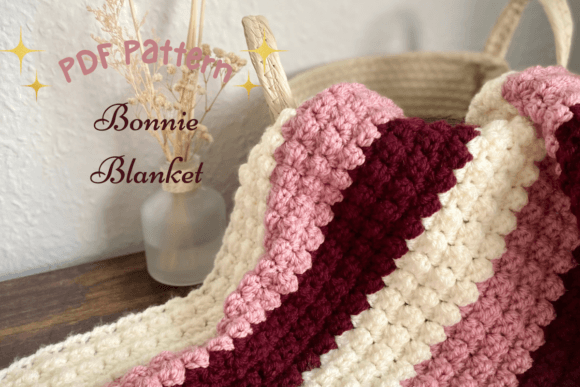
A file that states its size, like the Bonnie baby blanket, saves you the sum. The number of rows tells you how long the work is. The number of blocks tells you how big the blanket is. The two are not the same: a square of 30 by 30 blocks is still only 59 rows, because each row is a diagonal line of blocks.
So “how many rows” has no single answer. It depends on the size in cm you want and on how wide your block comes out, which is the next section.
C2C baby blanket size chart: finished size in cm, blocks and rows
Here is the sum worked for five common baby sizes. Each cell gives the blocks (wide by tall) and the rows. A block of 2.5 cm is the middle column, a typical worsted weight yarn on a medium hook.
| Finished size | 2 cm block | 2.5 cm block | 3 cm block |
|---|---|---|---|
| 60 by 60 cm | 30 by 30, 59 rows | 24 by 24, 47 rows | 20 by 20, 39 rows |
| 76 by 76 cm | 38 by 38, 75 rows | 30 by 30, 59 rows | 25 by 25, 49 rows |
| 76 by 94 cm | 38 by 47, 84 rows | 30 by 38, 67 rows | 25 by 31, 55 rows |
| 90 by 90 cm | 45 by 45, 89 rows | 36 by 36, 71 rows | 30 by 30, 59 rows |
| 100 by 100 cm | 50 by 50, 99 rows | 40 by 40, 79 rows | 33 by 33, 65 rows |
Read across a row and you see the same blanket in three yarns. The 76 by 76 cm square is 49 rows in a chunky yarn and 75 rows in a fine one, and the 2.5 cm column lands on 75 cm rather than 76 because 30 whole blocks cannot be split.
When the sum does not come out even, round to the nearest whole block and accept a centimetre either way. Never add half a block to chase the number.
If you would rather start from a file that prints the sizes itself, Sundae Snuggle includes a size chart of 5 sizes, from a baby’s receiving blanket up to a king.
What size should a C2C baby blanket be?
There is no standard. Of 54 free baby and lap blanket charts, only 42 name a size at all. Of those, the area differs by 4.4 times between the smallest and the largest.
The size most people call standard, 30 by 40 inches, turns up in only 2 of the 42. The middle of the group is a square of about 36 by 36 inches, or 91 by 91 cm, which is already a toddler throw rather than a pram blanket.
- 60 by 60 cm fits a pram or a car seat and takes 39 to 59 rows.
- 76 by 76 cm is the usual cot or gift size and takes 49 to 75 rows.
- 90 by 90 cm and up is a play mat or toddler throw and goes past 70 rows in most yarns.
To see the whole range laid out, the Sundae Snuggle size chart runs from receiving blanket to king in one file.
For a gift, 76 by 76 cm is where I would start. It is big enough to be used for a year and small enough to finish in a few weeks.
If the blanket is for a baby shower and you are still choosing a design, the baby blanket patterns guide lists sizes and stitches side by side.
From centimetres to blocks: measure four blocks and divide
The table needs one number from you, the width of a block in your yarn. A single block is too small to measure well, so make four.
- Crochet a strip of four blocks in the yarn and with the hook you plan to use.
- Lay it flat, without stretching, and measure it in centimetres.
- Divide by 4. A strip of 10 cm gives a 2.5 cm block.
- Divide the finished size by that number. For 76 cm and a 2.5 cm block that is 30 blocks.
Wash the strip the way you will wash the blanket. Cotton in particular grows a little, and the number you want is the washed one.
For a plain stitch to test on, French Countryside uses only double crochet, single crochet and chain, which makes the strip easy to read.
Then find your block in the table, or do the division yourself for any size in between. Ten minutes on the strip saves a blanket that comes out a hand too small.
Why the same C2C baby blanket is 49 rows in one yarn and 75 in another
A pattern is a set of blocks. It cannot know how wide a block is in your hands.
Take 76 cm. At a 3 cm block you need 25 blocks across and 49 rows. At 2 cm you need 38 across and 75 rows. Same blanket, a 26 row difference, and the finer version is slower by more than half.
This is why a free pattern that says “ch 2, rows 1 to 35 increase, rows 36 to 69 decrease” is right for the yarn it was written in and wrong for yours. The 35 blocks across come out near 76 cm only if the block is about 2.2 cm.
A thin yarn on a small hook gives a small, dense block. A chunky yarn on a big hook gives a block of 3 cm or more. Switching yarn means measuring again, not trusting the row count.
A throw pattern with a simple repeat, such as the Jaske throw, is written for a Medium-4 weight yarn, so you know what yarn the numbers belong to.
If you are still choosing a yarn, the Bernat Blanket guide works out how many balls a throw takes.
The increase, straight and decrease rows of a baby blanket, counted
Every C2C blanket has three kinds of row. The increase rows come first and each one has a block more than the one before. The straight rows keep the same length. The decrease rows end the blanket and each one has a block less.
The counts follow the sides of the blanket. Increase rows equal the shorter side in blocks. Straight rows are the longer side minus the shorter side. Decrease rows are the shorter side minus 1.
| Blocks (2.5 cm) | Increase rows | Straight rows | Decrease rows | Total rows |
|---|---|---|---|---|
| 24 by 24 | 24 | 0 | 23 | 47 |
| 30 by 30 | 30 | 0 | 29 | 59 |
| 30 by 38 | 30 | 8 | 29 | 67 |
| 36 by 36 | 36 | 0 | 35 | 71 |
| 40 by 40 | 40 | 0 | 39 | 79 |
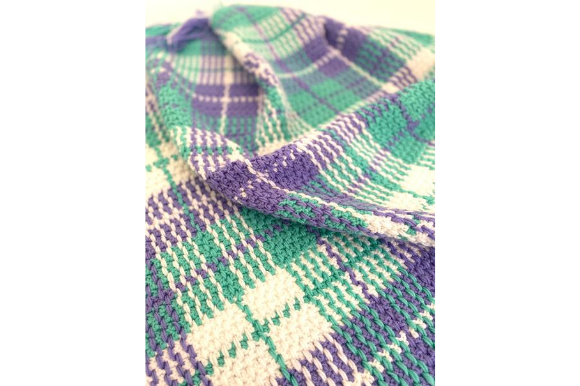
For comparison, the Tartan blanket is crocheted in one piece to give the effect of squares, a different construction from C2C. Put a marker at the end of the increase rows. The moment you stop adding a block is the moment the blanket is as wide as it will be.
My first one had me pulling the first blocks far too tight, and I paid for it across 30 rows. The stitch inside the block changes how quickly the rows grow, and the crochet stitches for blankets guide compares the common ones.
Square or rectangle: what the straight rows change
A square has no straight rows. A rectangle has as many as the difference between its sides, and that is the only thing that turns one into the other.
Take 76 by 94 cm, which is 30 by 37 inches. At a 2.5 cm block it is 30 by 38 blocks, 8 straight rows, 67 rows in all. At 2 cm it is 38 by 47, with 9 straight rows and 84 rows. At 3 cm it is 25 by 31, with 6 straight rows and 55.
The straight rows are the cheapest part of the blanket. Each one is the same length and the same stitch, so you can work them without the chart. Eight of them add 20 cm to the length and almost nothing to the effort.
To change a square pattern into a rectangle, work the increase rows until you reach the width you want, then add straight rows until the length is right, and start decreasing. You do not change the stitch count.
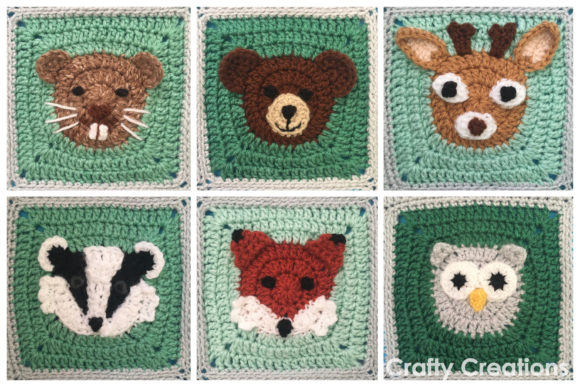
A pattern that is already a baby-sized rectangle, the Woodland Animal blanket, gives its finished size as about 95 by 65 cm, so you can see what that rectangle looks like before you start.
For the last step, the crochet blanket border guide shows how to finish four sides without the edge pulling the size out.
What to do when a free baby pattern gives no size in cm
Many give no size at all. 12 of 54 free charts do not name one, and the rest name inches.
Step 1. Convert the inches
Multiply inches by 2.5. A pattern of 30 by 30 inches is 76 by 76 cm, and 36 by 36 is 91 by 91 cm.
Step 2. Count the blocks
Take the blocks across from the chart. If the pattern names rows only, work back: blocks across = (rows + 1) / 2 for a square.
Step 3. Find the block
Divide the size in cm by the blocks across. If 35 blocks are meant to give 76 cm, the block is about 2.2 cm.
Step 4. Compare with your strip
Measure your own four blocks. If your block is wider, you need fewer blocks for the same size, so stop the increase rows earlier.
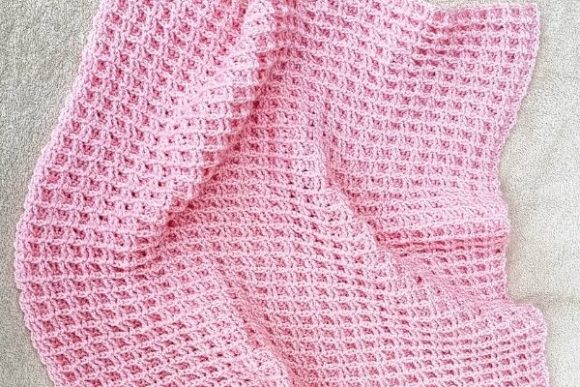
A file that states its size up front, like the Double Waffle baby blanket, which is written so that you choose your own yarn and colours, turns this into a lookup instead of a sum.
Do the sum before you buy yarn and test one strip before you commit to the first row. If the strip comes out wider than the block you need, change the hook and measure again.
If this is your first corner-to-corner blanket, the crochet blanket for beginners guide covers the stitches before the sums.
Where a free pattern stops and a file with a size chart starts
I use free patterns all the time. They cost nothing and for a plain baby square they are often enough.
They tend to stop in the same three places. They give one size, they give it in inches, and they do not say which yarn it was measured in.
A file fills those in. It names the sizes, the yarn weight and hook it was tested with, and it numbers the rows. Some add a video. The Bonnie baby blanket comes with a video tutorial and a size chart of 5 sizes, from a baby’s receiving size to a king.
I choose a file in three cases.
- The blanket is a gift and has to come out the size you said.
- I want to use a different yarn from the one in the pattern.
- The blanket is for a cot or larger, past 59 rows.
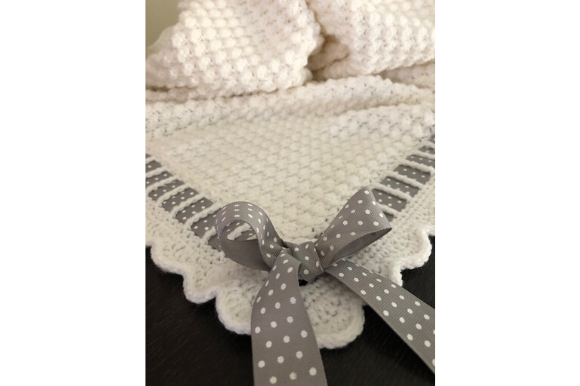
A small, versatile design like Mikeisha’s baby blanket, which you can begin in a neutral colour and finish with a ribbon accent, is a gentle one to start from.
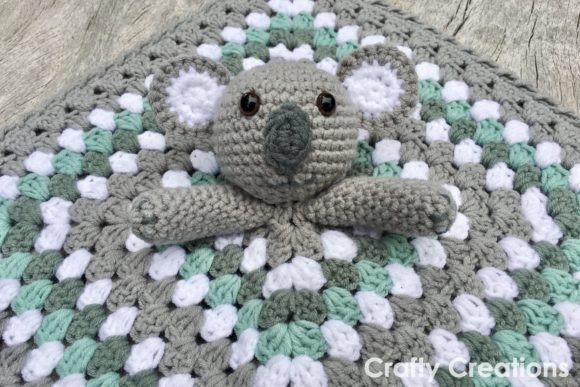
For a small lovey instead of a blanket, the Koala Lovey is a granny square of about 30 cm.
Stay with the free pattern when the blanket is small and plain, and use the sums on this page to fill in what it leaves out. For more easy things to make, see the easy crochet projects guide.

Questions about C2C baby blankets and finished size
How many rows is a C2C baby blanket?
Blocks across plus blocks down, minus 1. At a 2.5 cm block a 76 by 76 cm blanket is 30 by 30 blocks and 59 rows.
How many blocks for a 76 cm baby blanket?
30 across at a 2.5 cm block, 38 at 2 cm and 25 at 3 cm. Divide 76 by the width of your own block.
What size is a C2C baby blanket?
Most are 60 to 100 cm square. A common gift size is 76 by 76 cm, and 90 by 90 cm is a toddler throw.
How big is one C2C block?
Between 2 and 3 cm in most yarns on a medium hook. Measure four blocks and divide by 4 to get yours.
How do I make a C2C baby blanket a rectangle?
Work the increase rows to the width you want, add straight rows for the length, then decrease. A 76 by 94 cm blanket at 2.5 cm has 8 straight rows.
Do I need a paid pattern or is a free one enough?
A free one is enough for a small, plain blanket. A file that prints its sizes and rows is easier for a gift, for instance Sundae Snuggle.
If it goes wrong: the blanket does not come out the size you wanted
- It is the right block count and the wrong size in centimetres. The block is doing the work, not the chart: 76 cm square is 30 by 30 blocks at a 2.5 cm block but 38 by 38 at a 2 cm block. Measure a swatch of ten blocks and divide, then set the count.
- The row count is far off what the pattern said. The same 76 cm square runs 49 rows at a 3 cm block and 75 rows at a 2 cm block. If your rows are running long, your block is small, and the finished blanket will be square but shorter than planned.
- You wanted a rectangle and got a square. The straight rows are the rectangle: stop the increases at the shorter edge, work straight until the long edge is reached, then decrease. Increasing to the long edge gives a square every time.
- The blanket grows after the first wash. A loose block relaxes more than a firm one, so measure the swatch after you have washed it the way the yarn label asks, not straight off the hook.
If you would rather not run the sum at all, a written file such as Bonnie Baby Blanket gives the finished baby size and the block count together, and your swatch only has to confirm it.