Quick answer. Squares across = the width you want in cm divided by the width of one square. For 150 cm that is 75 squares at 2 cm, 60 at 2.5 cm and 50 at 3 cm. Measure one square from a swatch of 10, not 5, and the answer is good to a square or two.
You know the width the blanket has to be. The chart you found says “chain 6 and increase until you have 60 squares”, and 60 is the width of somebody else’s yarn.
The number you need is squares across for your width, in your yarn. It takes one division, and one measurement that most people take too quickly.
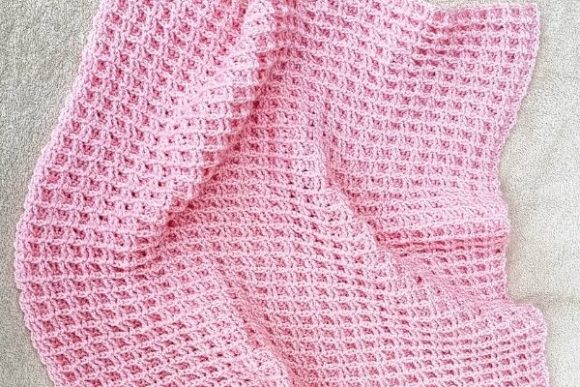
A written file such as Double Waffle states its finished size, so you can check your own sum against it.
Squares across = width in cm / width of one square. Width of one square = swatch in cm / squares in the swatch.
This guide gives you squares across for five common widths at three square sizes, shows how a small misreading turns into five squares, and shows how you can widen or narrow a chart you have already started. The full set of sizes with rows is in the C2C blanket size chart in centimetres.
How to crochet corner to corner for the width you want: how many squares across
You divide the width by the square. A blanket 90 cm wide in a 2.5 cm square is 36 squares across, because 36 x 2.5 = 90.
Squares across is the number you stop increasing at. A corner to corner blanket grows one square a row until the short side is reached, runs straight for the extra length, then decreases.
The short side of the rectangle is the squares across, so the width fixes how long the increase section is.
- Increase rows = squares across.
- Straight rows = squares down minus squares across.
- Decrease rows = squares across, minus 1.
For a 30 by 40 square rectangle that is 30 increase rows, 10 straight rows and 29 decrease rows, 69 rows in all. The width of 30 squares is the only number that had to come from you.
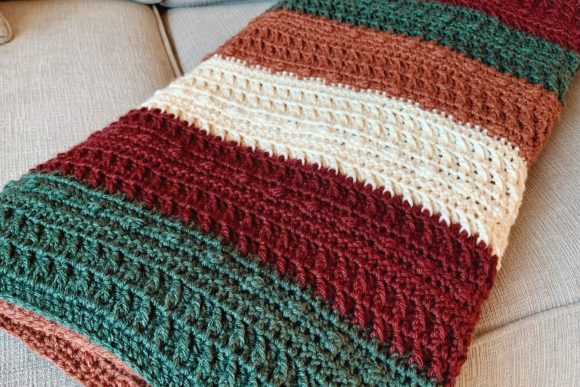
A pattern like the Jaske throw shows where its own increase stops.
Squares across for 60, 90, 120, 150 and 180 cm: a table at three square widths
You find the width you want in the first column and read across to the square you got from your swatch.
| Width you want | 2 cm square | 2.5 cm square | 3 cm square |
|---|---|---|---|
| 60 cm | 30 | 24 | 20 |
| 90 cm | 45 | 36 | 30 |
| 120 cm | 60 | 48 | 40 |
| 150 cm | 75 | 60 | 50 |
| 180 cm | 90 | 72 | 60 |
The table is the same sum repeated. If your square is 2.4 cm or 2.7 cm, you will land between two columns, so do the division and do not guess the column.
A pattern file that prints its width saves you the sum. Double Waffle is a written pattern for a baby blanket, and it is a fair file to check your own numbers against.
Measure one square: a swatch of 10 beats a swatch of 5
The square width is the one input that is yours. You crochet a swatch of squares in the yarn, hook and stitch of the blanket, lay it flat, and measure across the middle.
A swatch of 5 squares measuring 12 cm gives a 2.4 cm square. One measuring 13 cm gives 2.6 cm.
The two readings differ by 1 cm of tape measure, and that is easily done: the tape sits a little over the edge, or you pull the swatch a little.
A swatch of 10 squares is 24 cm for the 2.4 cm square and 25 cm for the 2.5 cm square. The same 1 cm now moves the square by 0.1 cm and not 0.2, so the error is halved.
I always make ten, because one extra row and column of work buys half the mistake.
- You work 10 squares by 10 squares, not 5 by 5.
- You lay it flat, do not stretch it, and measure in the middle.
- You divide the width by 10 and keep one decimal.
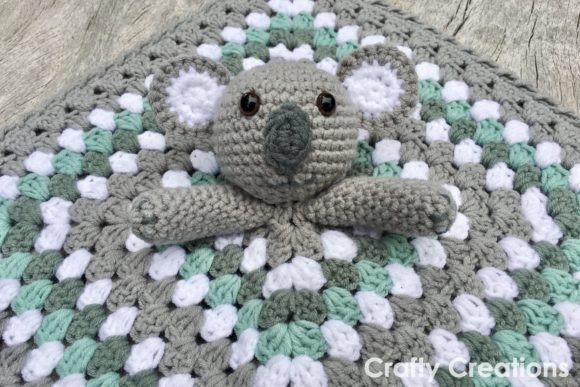
A small lovey such as the Koala Lovey turns the swatch into a finished piece, so it is not wasted yarn.
The 1 cm misreading that costs five squares
On a 150 cm blanket, a swatch of 5 squares read as 12 cm gives 62.5 squares across. Read as 13 cm, it gives 57.7. That is nearly 5 squares of difference from 1 cm of reading.
Five squares at 2.5 cm is about 12 cm of finished width. You plan 150 cm and get 138 or 162, and it is the swatch, not your stitching, that was off.
| Width | 5-square swatch, 12 cm | 5-square swatch, 13 cm | 10-square swatch, 24 cm | 10-square swatch, 25 cm |
|---|---|---|---|---|
| 90 cm | 37.5 | 34.6 | 37.5 | 36 |
| 120 cm | 50 | 46.2 | 50 | 48 |
| 150 cm | 62.5 | 57.7 | 62.5 | 60 |
| 180 cm | 75 | 69.2 | 75 | 72 |
Read the 150 cm row. The two 5-square readings are 4.8 squares apart, and the two 10-square readings are 2.5 apart. That is the whole reason to make the bigger swatch.
You round the answer to a whole square, and the stray half goes into the border.
If the number is close to a whole square, you are safe. If it lands on x.5, wash the swatch and measure again before you commit, as Mikeisha’s Baby Blanket does when it names its yarn and hook.
Squares across set the width, straight rows set the length
A C2C rectangle has two numbers. Squares across fixes the short side. You make the long side with the straight rows between the increase and the decrease, and each straight row adds one square of length.
To lengthen a blanket without making it wider, you add straight rows. To make it wider, you must raise the squares across, and the increase section gets longer with it.
That is why changing the width changes the total, and changing the length only adds rows.
A 150 cm wide blanket in a 2.5 cm square is 60 across. For a length of 200 cm, that is 80 squares down, so 20 straight rows, and 139 rows in all.
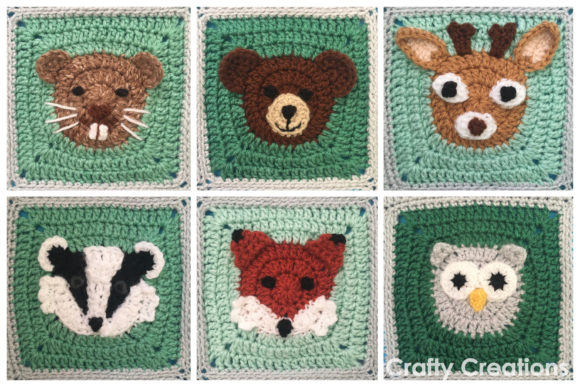
For the other half of the sum, the C2C chart row count guide turns squares across and down into rows, and the Woodland Animal blanket shows a rectangle worked this way.
Squares are wider than they are tall: measure both ways
A square is not always square. A double crochet block is often a touch wider than it is high, and a looser tension makes it more so.
That matters because squares across uses the width of the block, and squares down uses its height. If you measure the swatch only across, you get a good width and a length that is out by a few squares.
- You measure the swatch across for squares across.
- You measure it down, in the same 10 squares, for squares down.
- You use the two numbers separately in the two sums.
It is the usual reason a blanket that is the right width is short. If the height of a square is 2.3 cm and the width 2.5 cm, 60 squares down is 138 cm, not 150.
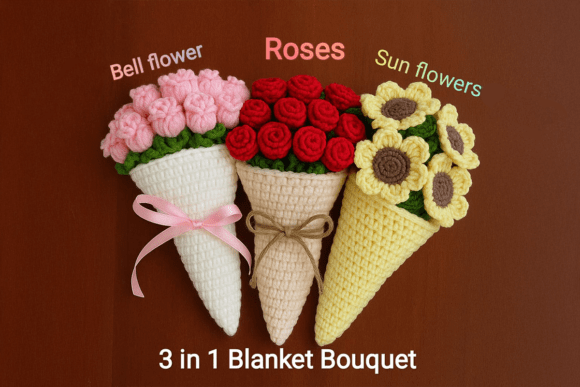
The crochet stitches for blankets guide shows how wide each stitch runs, and Blanket Bouquet is a bundle of three patterns you can compare.
Change the width of a chart you have already started
You can widen or narrow a chart that is not finished, as long as you do it before the straight section.
- You count the squares across on the last row of the increase.
- You multiply by your square to get the width so far.
- You divide the width you want by your square to get the new squares across.
- You keep increasing until you reach that count, then go straight.
Narrower is simpler: you stop increasing early and start the straight rows. Wider means more increase rows, and the same number of extra rows come off at the decrease, so the blanket grows by twice the added squares in rows.
A chart you have started and want resized is easier to change than one you have finished. I count first and put a marker in the last increase row.
The crochet blanket for beginners guide covers keeping the edges straight while you do it, and Sundae Snuggle prints sizes you can compare with.
A worked example: 120 cm wide, 160 cm long
Take a 10 square swatch that measures 25 cm across and 23 cm down. The square is 2.5 cm wide and 2.3 cm high.
- Squares across: 120 / 2.5 = 48.
- Squares down: 160 / 2.3 = 69.6, so 70.
- Increase rows: 48. Straight rows: 70 – 48 = 22. Decrease rows: 47.
- Rows in all: 48 + 70 – 1 = 117.
If you ignore the height and use 2.5 cm for both, squares down would be 64, and the blanket would be 147 cm long, 13 cm short of your plan. The extra 6 squares are the cost of one extra measurement.
You should wash or steam the swatch the way you will treat the finished blanket. A cotton swatch can grow by 1 cm over 10 squares, which is 0.1 cm a square and 5 cm on 48 squares across.
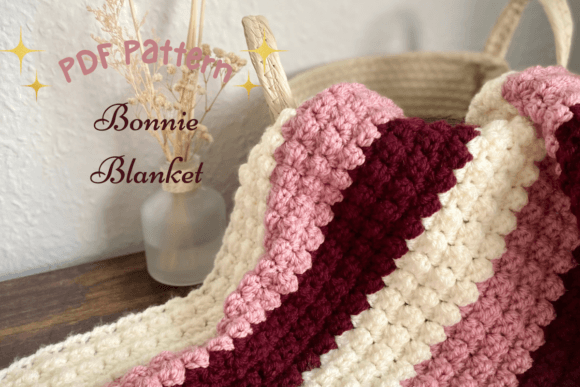
The same sum on a throw is in the baby blanket guide with the finished size in cm, and the Bonnie baby blanket prints several sizes.
Rounding, borders and the half square you cannot make
The sum rarely comes out whole. 62.5 squares across is 62 or 63, and you cannot make half a square.
You round to the nearest whole number and let the border take up the rest. One round of double crochet adds about 2 cm to each side, so a blanket 3 cm narrower than you planned can be brought back with a border of 2 rounds.
The crochet blanket border guide gives the stitch counts.
If the result is more than 5 cm out, I change the squares across by one or two, not the border. A border that is doing the work of the body pulls the edge, and you will see it in the first wash.
French Countryside is an easy blanket to try this on.
Yarn and hook change squares across, not the chart
A chart is a count of squares. It says nothing about centimetres. Put the same chart in a thinner yarn and the blanket is narrower, in a thicker yarn and it is wider, and the squares across have not moved.
A worsted yarn on a 4 to 5 mm hook usually gives a square of about 2.5 cm. A finer yarn on a smaller hook lands nearer 2 cm, a bulky one nearer 3.
Those are habits, not rules, so you still let the swatch decide.
When a chart is made for one yarn and you want another, you keep the chart and change the width you aim for: divide it by your own square. The Koala lovey is a written pattern in US terms with its yarn named, which makes it easy to see what its count belongs to.
A free chart or a file with the width printed
A free chart gives you a grid of squares and a finished size in inches for one yarn. That is enough if you do the sum above, and it is the right choice for a plain blanket in the yarn you already have.
A file with the width printed is for the cases where the size has to be right: a gift for a named person, a bed, a pram. It gives you the yarn, the hook and the squares across at several sizes, so the division is already done.
The Jaske throw and the Woodland Animal blanket are two to compare.
I would use a free chart for myself and a file for a gift. For a baby blanket in particular, the baby blanket guide with the finished size in cm works five small sizes through.

Questions about C2C corner to corner crochet blanket width
What is a C2C crochet blanket?
It is a blanket worked in diagonal rows of small squares, from one corner to the opposite corner.
How many squares across for a 150 cm blanket?
You need 60 at a 2.5 cm square, 75 at 2 cm and 50 at 3 cm.
How to start a corner to corner crochet blanket?
You chain 6, work a double crochet into the 4th chain from the hook and the next two chains, then increase one square a row until you reach the squares across.
How to decrease a corner to corner crochet blanket?
Once the straight rows are done, you work one square fewer each row, for the same number of rows as the squares across minus 1.
How to crochet corner to corner for beginners, step by step?
You work out the squares across first, increase to that count, go straight for the length, then decrease. The rest is the same three-stitch square.
How to finish a corner to corner crochet blanket with a border?
You work one or two rounds of double crochet round the edge, with 3 stitches in each corner. The best border is the plainest one.
What is the best yarn for a corner to corner blanket?
A worsted weight yarn on a 4 to 5 mm hook gives a square of about 2.5 cm, which is the easiest column of the table to work with. French Countryside is one to try it on.
How to make a corner to corner crochet blanket rectangle?
You choose squares across for the width, squares down for the length, and add straight rows equal to the difference.
Do I need to measure the height of a square too?
Yes. Width sets squares across and height sets squares down, and the two are often not equal.