Quick answer.
- Three colours: light, dark, and a middle shade where a light band crosses a dark one.
- Middle shade share: about half of all blocks, whatever the band width.
- Band width: 4 blocks (10 cm) means 856 colour pieces in a 100 by 130 cm blanket; 2 blocks means 1322.
- Buy first: the middle colour, all of it, in one go.
You pick three yarns for a C2C gingham blanket and the pattern says “light, mid, dark”. It does not say how much of each, and the middle yarn turns out to be the one you run short of. I have bought the wrong amount of that yarn myself, so here is the sum you can do before you shop.
A written file that names its yarn and prints its sizes, such as Sundae Snuggle, shows what a pattern should tell you before you buy.
Middle shade = about half of all blocks. Light plus dark = the other half.
The middle shade is not an accent. In a gingham blanket it covers about half of the blocks, so a skein from the wrong dye lot shows across half of the blanket, not in a corner.
This guide gives the share of every colour, the cost of narrow bands, and what to do when the middle yarn does not match. For the squares and rows of the blanket itself, see the C2C size chart in centimetres.
C2C gingham crochet blanket: which of three colours goes where
Gingham is a check made of bands. A band of the dark colour runs across the blanket, another runs down, and the two cross.
- Light: the blocks where no dark band passes. This is the background.
- Middle: the blocks where one dark band passes. It reads as a lighter tint of the dark colour.
- Dark: the blocks where two bands cross.
That is why the check looks woven. The middle shade is what you see where a band goes “over” the background, and the dark square is where two bands are layered.
Work it in C2C and every block is one of the three colours, chosen by where it sits in the grid. A diagonal row cuts through the check, so one row can hold light, middle and dark blocks in turn.
Before row one, check the three colours in a small test, not only on the label.
- Crochet a few blocks in each colour and join them side by side.
- Put the middle block between the light and the dark ones.
- Look at it in daylight and under a lamp. A middle shade that looks right in one light and wrong in the other will do the same on the sofa.
The middle colour should read as a mix of the other two. If it looks like a third colour on its own, the check will look like stripes, not gingham.
For a plain written pattern to read alongside, Mikeisha’s Baby Blanket starts in a neutral colour and adds its accent later, which is the same order of choosing.
Pro tip: choose the middle colour first, then the light and the dark around it.
Gingham or plaid: what is the difference in a C2C blanket
Gingham has bands of one width, the same across and down, in three tones. Plaid has bands of different widths and often more colours.
Buffalo plaid is the best known version: a dark colour, a light colour and a blend, usually red, black and a wine shade. A softer gingham in pastel suits a baby blanket, with a main colour, white and a mid tone.
One warning before you open a plaid pattern. Some plaid blankets are worked in griddle stitch, which alternates single and double crochet. That is not the block stitch of ordinary C2C, so the written rows are not interchangeable between the two.
If you can already work a C2C block and a diagonal row, gingham needs nothing more than colour changes. An easy file such as Double Waffle is written for advanced beginners for practising another pattern first.
Where the colours meet: the middle shade is half of the blanket
Take any band width from 2 to 6 blocks and count the blocks by colour. The middle shade stays at about 50 per cent every time.
It follows from the grid. A block is middle when exactly one of its two bands is dark, and that is true for half of all positions. Light and dark take a quarter each, give or take the edges.
- Middle: 1032 to 1040 of 2080 blocks.
- Light: 520 to 616 blocks.
- Dark: 432 to 520 blocks.
The edges of the blanket decide the difference between light and dark. A blanket that starts and ends on a light band has more light blocks, one that ends on a dark band has more dark.
Light or dark can be topped up later without much harm. The middle cannot.
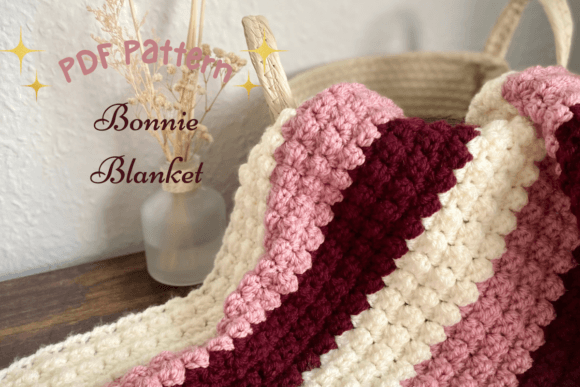
The takeaway is simple. The yarn you think of as the “third” colour is the largest of the three. Treat it as the main yarn of the blanket. For a file to compare against, Bonnie Baby Blanket prints a size chart of 5 sizes.
How many blocks of each colour for a 100 by 130 cm blanket
A 100 by 130 cm lap blanket with a 2.5 cm block is 40 by 52 blocks, 2080 in all. These are the counts for the five band widths you are likely to choose.
| Band width | Light blocks | Middle blocks | Dark blocks |
|---|---|---|---|
| 2 blocks (5 cm) | 520 | 1040 | 520 |
| 3 blocks (7.5 cm) | 567 | 1038 | 475 |
| 4 blocks (10 cm) | 560 | 1040 | 480 |
| 5 blocks (12.5 cm) | 540 | 1040 | 500 |
| 6 blocks (15 cm) | 616 | 1032 | 432 |
I always split the yarn on paper first, the same way the baby blanket sizes in cm are worked out. You should too, because it takes two minutes. Use the table to split your yarn before you start. Half goes to the middle colour, and the other half is shared between light and dark in the proportion of the row you chose.
Different yarn gives a different block, so the numbers scale. For another size, take the blocks across and down from the size chart and divide the grid into bands of your width.
You can check your split against a file that prints its sizes, for example Sundae Snuggle.
My habit is to weigh the middle colour first and set it aside. Everything else is arithmetic from there.
A worked example: splitting the yarn for a 4-block check
Take the classic check, 4 blocks wide, so 10 cm bands, in the 100 by 130 cm blanket. The 2080 blocks split like this.
- Middle: 1040 blocks, 50 per cent of the blanket.
- Light: 560 blocks, 27 per cent.
- Dark: 480 blocks, 23 per cent.
Now turn it into a shopping rule. The middle colour needs about as much yarn as the light and the dark put together. If you buy equal skeins of the three, the middle runs out first and you reorder it from a new lot.
Change the band to 2 blocks and the split is 520, 1040 and 520. The light and the dark are equal and the middle is still half. Change it to 6 blocks and the split is 616, 1032 and 432, so the light is now the second biggest.
That is the reason for the order in this guide: fix the band width, read the split, then buy. Buying first and choosing the check later is how the odd lot ends up in the middle.
For a second set of sizes to compare, Bonnie Baby Blanket gives a chart of 5.
My rule is to buy the middle colour for the whole blanket on day one. The light and the dark are easy to top up, because a small difference at the corner of a check is not noticed.
Pick the stripe width: 5 cm bands give 1322 colour pieces, 15 cm give 637
The band width changes how often you change yarn. In a diagonal row, a colour piece is one unbroken run of one colour. Each piece means a new strand, a bobbin or a carried yarn, and later an end to weave in.
| Band width | Colour pieces in the blanket | Most pieces in one row |
|---|---|---|
| 2 blocks (5 cm) | 1322 | 40 |
| 3 blocks (7.5 cm) | 1085 | 27 |
| 4 blocks (10 cm) | 856 | 20 |
| 5 blocks (12.5 cm) | 733 | 16 |
| 6 blocks (15 cm) | 637 | 14 |
You can try it yourself on a swatch. I tried a 2-block check once and gave up on the bobbins. You will see why: the narrowest check needs 2.08 times as many pieces as the widest. The blanket is the same size and uses the same yarn, but the work at the ends is more than twice as much.
- 5 cm bands: a fine, busy check. Up to 40 pieces in a row, so 40 loose strands at the widest diagonal.
- 10 cm bands: the classic look. At most 20 pieces in a row.
- 15 cm bands: bold squares and the quickest work.
For a first gingham, choose 4 blocks. It reads as a check from across the room and keeps the bobbins manageable. For the chart itself see the free C2C charts with row counts. A pattern with a video, like Bonnie Baby Blanket, helps you see the first colour changes.
Gingham crochet pattern: reading the chart row by row
A gingham chart is a grid of coloured squares. Each square is one C2C block, and you read it along the diagonals, not along the rows of the picture.
- Start at the corner. The first block is row 1.
- Row 2 holds the next two blocks on the diagonal, and so on.
- On each row, change colour where the chart changes colour.
- Past the middle of the blanket the rows shorten again, as in any C2C blanket.
A chart is easier to follow than written rows, because the colour change sits where you see it. It also lets you tick off a row as you go.
If a pattern file prints the sizes and the yarn it was made with, you do not have to guess. Sundae Snuggle includes a size chart of 5 sizes and names a worsted yarn with a 5 mm hook, which makes it a good model of what to look for.
The middle shade is from another dye lot: what to do
Skeins of the same colour name can differ slightly between dye lots. The lot number is printed on the label. In gingham the middle colour is half of the blanket, so a mismatch is hard to hide.
Plan it before you buy:
- Buy the middle colour first and in one go, for half of the blanket’s yarn.
- Check the lot number on every label before you leave the shop.
- Keep one spare skein of the middle colour aside until the last row.
If the mismatch has already happened, use the new skein in a way that blurs the join instead of a hard change.
- Work two rows from the old skein and two from the new, then one and one.
- Keep the switch inside the middle blocks, not at a point where middle meets dark.
- Step back and look at the blanket from across the room before you go on.
This is not a fix for a very different shade. For that, the old lot goes to one half of the blanket and the new to the other, so the line reads as design.
If you would rather start from a neutral base and add colour later, Mikeisha’s Baby Blanket is built that way.
Pro tip: take a photo of the labels in the shop, so you have the lot number when you reorder.
Where to start the new ball so the join does not show
Join a new ball at the start of a block, not in the middle of one. The join is then hidden inside the stitches of the block.
- Change at the end of a block, after the last double crochet of it.
- Leave a 15 cm tail and weave it into blocks of the same colour.
- Do not join on the turn between two colours, where the tail would show through the lighter block.
In gingham a dark tail woven into a light block shows through. Weave each end into a block of its own colour.
The wider the band, the fewer ends there are to weave in. This is the reason for the 856 against 1322 in the table above: every colour piece is an end. You will weave in fewer ends on a simple file such as Double Waffle, and that is a fair first project to test your joins.
Bobbins or carrying the yarn on the wrong side
You have two ways to hold a colour you are not using. Both work; the choice depends on the band width.
- Bobbins: a small ball for each colour piece. The fabric stays clean, because nothing is carried across the back.
- Carrying: the yarn runs along the wrong side to the next block of its colour. Quicker, but it can pull.
Narrow bands of 2 blocks with up to 40 pieces in a row suit neither, and that is the practical reason to avoid them in a first blanket.
At 4 blocks you need at most 20 bobbins at the widest row. Carrying works across a gap of one block and no further.
Dropping and picking up the yarn on the wrong side keeps the fabric dense. Carrying it through the stitches can show a shadow in the lighter block.
You will pull the wrong colour at least once. You can undo it, so do not worry. You will also see the check more clearly after a few rows.
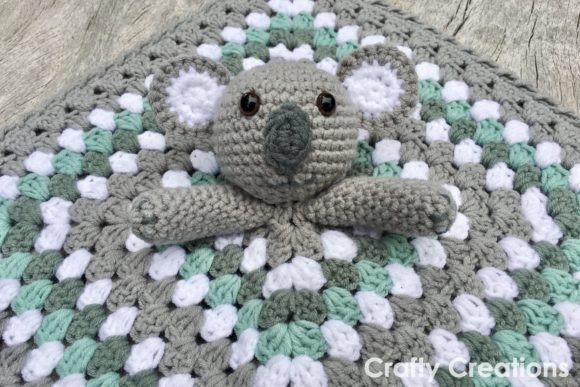
For a chunkier look, the chunky C2C skein counts show how thick yarn changes the sums. Practise the joins on a small piece first. The Koala Lovey is about 30 cm square, so a test blanket does not take long.
For the stitch itself, the C2C stitch comparison shows how the block changes with the stitch you choose.
Chart, kit or a file with the colour counts printed
You can take any of three routes to a gingham blanket.
- A free chart costs nothing, but it often stops at the colour layout and leaves the yarn amount to you.
- A kit gives you the yarn in one lot, which solves the dye lot problem.
- A file with sizes printed saves the arithmetic and shows the stitch counts.
Use the table in this guide and a free chart when you are comfortable with the sums. Choose a kit or one batch of yarn when the blanket is a gift and the colours must match.
A written file with video support helps with the first colour changes. Bonnie Baby Blanket includes a link to a video tutorial and a size chart of 5 sizes, from a receiving blanket to a king. Mikeisha’s Baby Blanket starts in a neutral colour and adds the accent later.
If you are new to the stitch, the crochet blanket for beginners guide comes first.

Questions about C2C gingham crochet blankets
How do I start a C2C crochet blanket?
Chain 6, work a double crochet into the 4th chain from the hook and the next two chains, then increase one block a row until you reach the width you want.
How do I crochet a rectangle C2C blanket?
Increase one block a row until you have the blocks across, then work straight rows until the length is right, and decrease to the last corner.
How many colours does a C2C gingham blanket need?
Three: a light, a dark and a middle shade where the bands cross. The middle shade covers about half of the blocks.
What is the difference between gingham and plaid in C2C?
Gingham has bands of one width across and down. Plaid has bands of different widths and often more colours.
How do I change colours in C2C crochet?
Finish the block in the old colour, pick up the new one for the first stitch of the next block, and weave the tails into blocks of their own colour.
Does the stripe width change the work?
Yes. In a 100 by 130 cm blanket, 5 cm bands make 1322 colour pieces and 15 cm bands make 637.
Can I use a different dye lot for the middle colour?
You can, but it will show, because that colour is half of the blanket. Alternate the skeins every two rows to blur the join.
Do I need a paid pattern for gingham?
No. You need the block counts and a chart. A file such as Sundae Snuggle is only worth it when you want the sizes printed.