Quick answer. A C2C blanket has blocks across plus blocks down, minus 1, diagonal rows: 69 at 30 by 40 blocks, 109 at 50 by 60. Width in cm is blocks across times one block, usually 2 to 3 cm. Six sizes are worked out below.
You found a free C2C chart you love, scrolled to the end and there is no row count and no size. Just a grid of coloured squares.
I have been there with a pencil and a bad guess. The pattern page tells you how to make one block and leaves the sum to you. A written file such as Sundae Snuggle prints its sizes, which is the gap a free chart leaves.
Rows = blocks across + blocks down – 1. Width in cm = blocks across x the width of one block.
This guide does the sum once, for six common sizes, so you can read any corner-to-corner chart and know how many rows you are signing up for. If the stitch itself is still new, the walk through on how to crochet corner to corner covers the increase and decrease corners first.
It covers the row count, the three kinds of rows inside it, how wide one block is and why the same chart comes out a different width in another yarn.
How many rows does a C2C blanket have?
Add the blocks across to the blocks down, then take away 1. That is the number of diagonal rows.
A blanket 30 blocks wide and 40 blocks tall is 30 + 40 – 1 = 69 rows. A square 20 by 20 is 39 rows.
The minus 1 is there because the first block is both the first row and the corner of the first column. Count it once.
The same sum works for any chart, whether it is a plain blanket or a graphgan with a picture on it. Count the squares along the top, count them down the side, and you have the rows.
I count rows on paper before I touch the yarn, and I have not been surprised by a size since.
Rows are not the same thing as blocks. A 30 by 40 blanket has 1200 blocks but only 69 rows, because every row is a diagonal line of blocks.
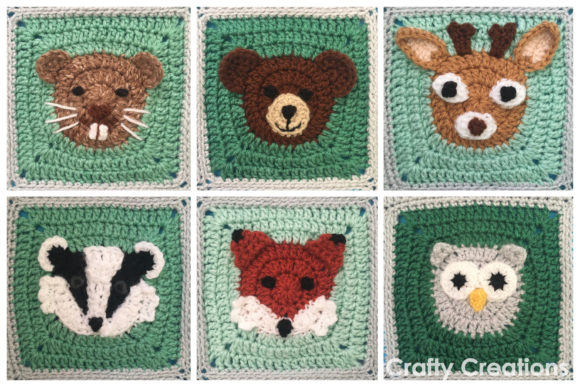
A pattern that names its size, like the Woodland Animal blanket states its finished size, about 95 by 65 cm, up front. For a chart that gives no size, the sum above works.
That is why the work feels short on the hook and long on the chart. You are not crocheting 40 rows. You are crocheting 69 short ones that grow and then shrink.
C2C blanket size chart: blocks, rows and width in cm
Here is the sum worked for six sizes. The width and height columns assume a block of 2.5 cm, which is a common middle value for a worsted weight yarn on a medium hook.
| Blocks (wide by tall) | Rows | Blocks in total | Finished size at 2.5 cm a block |
|---|---|---|---|
| 20 by 20 | 39 | 400 | 50 by 50 cm |
| 30 by 40 | 69 | 1200 | 75 by 100 cm |
| 40 by 50 | 89 | 2000 | 100 by 125 cm |
| 50 by 60 | 109 | 3000 | 125 by 150 cm |
| 60 by 72 | 131 | 4320 | 150 by 180 cm |
| 80 by 100 | 179 | 8000 | 200 by 250 cm |
If your block is 2 cm, multiply the blocks by 2 instead. At 3 cm, multiply by 3. The 40 by 50 blanket is 80 by 100 cm at 2 cm a block, and 120 by 150 cm at 3 cm.
That is a 40 cm swing in width for the same chart and the same number of rows. It is why a row count alone never tells you the size.
The first row of the table is a baby or lap blanket, the middle three are throws, and the last two are for a bed. For a first project the 30 by 40 is a size you can finish.
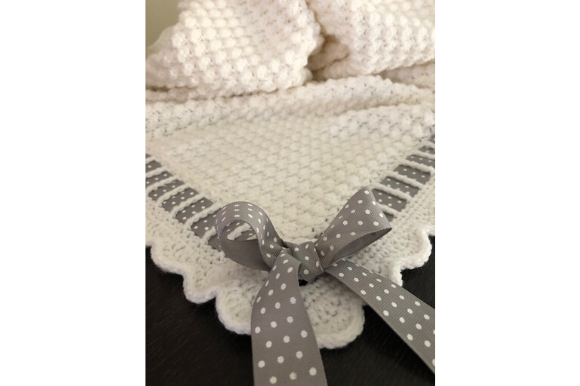
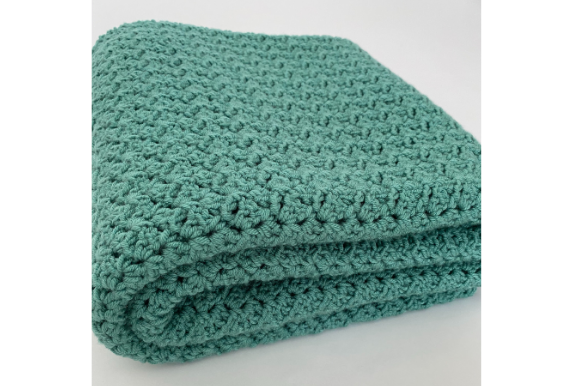
If you would rather start from a file that prints its own sizes and its rows, the Sundae Snuggle blanket pattern lists five sizes from a receiving blanket to a king, so you can check your sums against it.
How wide is one C2C block? Measure yours in four blocks
Do not trust the number on a pattern, and do not trust my 2.5 cm either. Measure your own block before you start.
One block alone is too small to measure well. Four give you a number you can divide.
- Make a strip of four blocks in a row, the way the pattern builds them, with the yarn and hook you plan to use.
- Lay it flat without stretching and measure the length of the strip in centimetres.
- Divide by 4. That is the width of one block.
- Multiply it by the blocks across to get the finished width, and by the blocks down for the height.
A strip of four that measures 10 cm gives 2.5 cm a block. On a 40 by 50 chart that is 100 by 125 cm.
I always wash my strip, because my cotton blocks grew by a few millimetres.
Wash and dry the strip the way you will wash the blanket if you can. Cotton in particular grows a little after the first wash.
For a plain pattern to test your block on, French Countryside uses only double crochet, single crochet and chain, which makes the strip easy to read.
Then plug the figure into the chart above, or into your own chart, and stop guessing. Ten minutes of crochet saves a blanket that comes out a hand narrower than the sofa.
Why the same C2C chart comes out a different width in another yarn
A chart is a grid of squares. It does not know how big a square is.
The size of a square comes from the yarn, the hook and the stitches in a block, and your hand. Two people can crochet the same 50 by 60 chart and end up with blankets that are a clear 25 cm apart in width.
A thin yarn on a small hook makes a small, dense block, near the 2 cm end of the table. A chunky yarn on a big hook makes a block near 3 cm, or more.
The number of blocks is fixed by the chart. The size of each block is yours. Everything on a graphgan, the picture included, scales with it.
This is the practical point for anyone who read a pattern in one yarn and wants to use another. Do not swap yarn and trust the row count. Swap yarn, measure four blocks again, and redo the width.
I switched from worsted to chunky once and my width jumped by a hand.
The same goes for a block of a different shape. Some patterns work a block as three double crochet and some as a shell. A bigger block means fewer blocks to the same width, so check which block the chart was drawn for.
A throw pattern with a simple repeat, such as the Jaske throw, is a good place to test a new yarn before a large chart.
If you are choosing yarn for a blanket, the Bernat Blanket guide works out how many balls a throw takes, which pairs with the width sums here.
How to read a C2C chart: rows run on the diagonal
A chart looks like a square grid, but you do not work it left to right. You work it corner to corner, on the diagonal.
Row 1 is the single square in the corner. Row 2 is the two squares touching it, row 3 is the three squares after that, and so on.
Each diagonal row runs from the lower left to the upper right and then back, and the squares you work in one row all sit on one slanted line of the chart.
On a numbered chart, the number on a square tells you its row. Squares with the same number belong to the same pass.
A colour change is read the same way. When the colour of a square differs from the one before it on the diagonal, you change yarn there.
Two things trip people up, and I did both on my first blanket.
- Working across the chart row by row like cross stitch, which gives you a different shape.
- Losing the place when the row turns, so put a marker at the end of each row on the chart.
- Changing colour on the wrong square, so tick off each diagonal as you finish it.
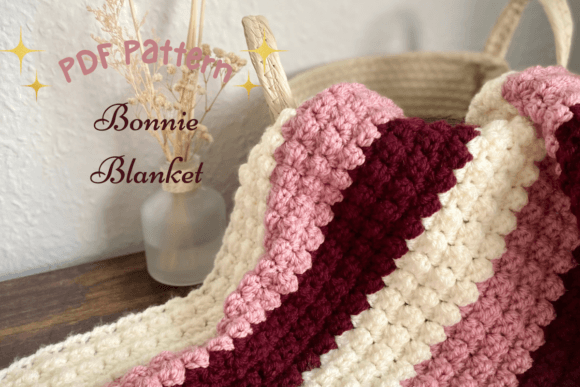
A pattern that comes with a video, such as the Bonnie baby blanket, lets you follow along on screen, which makes losing your place harder.
If the whole method is new to you, the crochet blanket for beginners guide covers the stitches, and then this page gives you the counts.
The increase rows of a C2C blanket, counted
The first rows of the blanket get longer by one block each time. These are the increase rows.
How many are there? As many as the shorter side of the blanket, in blocks.
A 30 by 40 blanket has 30 increase rows, rows 1 to 30, with row 30 reaching 30 blocks. A 50 by 60 has 50, and an 80 by 100 has 80.
In an increase row you make one more block than the row before.
- Row 1 is one block, row 2 is two, row 3 is three.
- You start each row with a turning chain and work into the block below.
- You add one block at the end of the row.
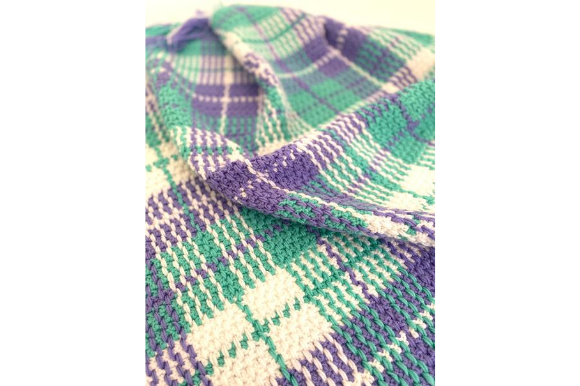
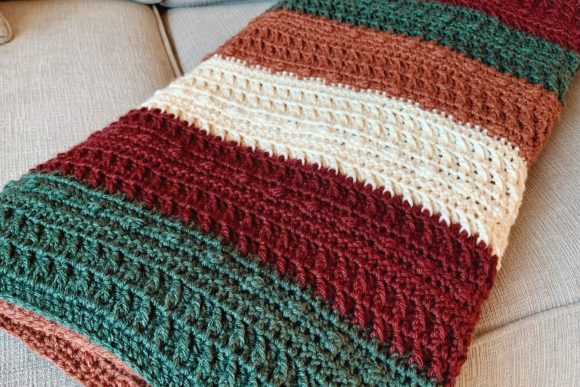
I find the increase rows the easiest place to learn the stitch, because the rows are short. The Tartan blanket is a different construction, a blanket worked in one piece with plain rows, and a fair first step if the diagonal feels like too much.
My first blanket had me pulling the first block far too tight, and I paid for it for 30 rows.
The increase rows are where the blanket is slowest. They are also the part where the corner takes shape, so keep your tension even and do not pull the first block tight.
Put a row marker every 10 rows. You will want it later.
The stitch you use inside each block changes how fast the rows grow, and the crochet stitches for blankets guide compares the common ones.
The straight rows and the decrease rows, counted
After the increases come the straight rows. They have the same number of blocks as the last increase row, and the blanket grows only in length.
The number of straight rows is the longer side minus the shorter side. A 30 by 40 has 10 straight rows. A 60 by 72 has 12.
A square has none. A 20 by 20 goes straight from increasing to decreasing, and row 20 is the longest row with 20 blocks.
Then come the decrease rows, and there is one fewer of them than the increase rows. The 30 by 40 has 29, the 50 by 60 has 49.
Put together, the 30 by 40 is 30 increase, 10 straight and 29 decrease rows, which is 69 and matches the table. The 60 by 72 is 60, 12 and 59, which is 131.
| Blocks | Increase rows | Straight rows | Decrease rows | Total rows |
|---|---|---|---|---|
| 20 by 20 | 20 | 0 | 19 | 39 |
| 30 by 40 | 30 | 10 | 29 | 69 |
| 40 by 50 | 40 | 10 | 39 | 89 |
| 50 by 60 | 50 | 10 | 49 | 109 |
| 60 by 72 | 60 | 12 | 59 | 131 |
| 80 by 100 | 80 | 20 | 79 | 179 |
In a decrease row you work one block fewer than the row before, so the rows get shorter by one block each time. The last row is a single block, the opposite corner from where you started.
If you bring a size chart to the shop, Mikeisha’s baby blanket is a simple file to compare it with, because the blanket is plain and neutral.
The last job is the edge, and the crochet blanket border guide shows how to finish the four sides.
When you know where the straight rows end, you also know how far through the blanket you are. Half of the total rows is the middle of the work.
How to turn a free graphgan chart into a size you know
A free graphgan chart tells you the picture. It rarely says how big the picture will be. Here is how to find out in four steps.
Step 1. Count the squares across and down
Count along the top edge and down the left side. That gives you blocks wide and blocks tall. Use the sum from the first section for the rows.
Step 2. Measure your block
Make the strip of four blocks in the yarn you own and divide by 4, as in the measuring section above.
Step 3. Multiply
Blocks across times block width gives you the width. Blocks down gives the height. A chart 50 wide and 60 tall at 2.5 cm is 125 by 150 cm.
Step 4. Change the block, not the chart
If the answer is too big, do not cut rows off the chart. A picture drawn on 50 by 60 squares becomes a different picture on 40 by 48. Use a thinner yarn and a smaller hook instead, so each block gets smaller and the whole picture shrinks with it.
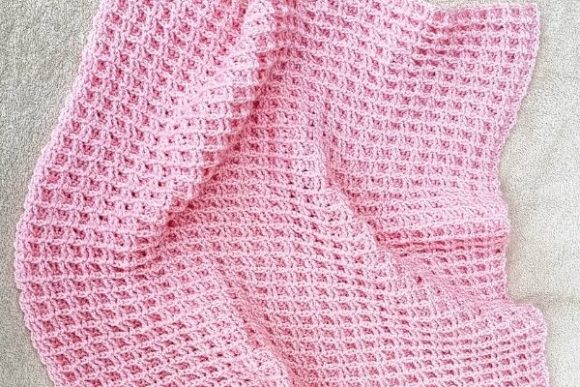
A file that states its size up front, like the Double Waffle baby blanket, turns step 1 into a lookup instead of a count.
To get 100 cm of width from a chart 50 blocks wide, you need a block of 2 cm. To get it from a chart 40 blocks wide, you need 2.5 cm.
If you are new to the stitches and want an easier start, the easy crochet projects guide has smaller things to practise on first.
Work the maths on paper before you buy the yarn, and test one strip before you commit to the first row. If the strip says 2.8 and you need 2, change the hook and measure again.
For a heavier throw once you have a size you like, the crochet throw guide goes through the finishing.
Where a free chart stops and a pattern file starts

I use free charts all the time, and I still keep a notebook beside them for the sums.
A free chart is a good thing. It shows you the picture and costs you nothing, and for a first blanket it is often all you need.
It usually stops in three places. It does not give a row count, it does not give a width in centimetres, and it does not write the rows out, so you read each diagonal from the picture.
That is fine for a 20 by 20 cushion-size project. On a 60 by 72 blanket, with 131 rows, a written file earns its keep.
A pattern file adds what the chart is missing. It states the sizes, the yarn and hook it was tested with, and it numbers the rows. Some add a video you can crochet along to, as the Bonnie baby blanket pattern does.
I pick a file in three cases.
- The blanket is big, 50 by 60 blocks or more.
- It has a colour change on most rows.
- It is a gift and has to come out the size you say.
If the blanket is a gift for a baby, the baby blanket patterns guide lists sizes that are safe to aim for.
Stay with the free chart when the blanket is small and plain, and use the sums on this page to fill in what it leaves out.

Questions about C2C charts and row counts
How many rows is a C2C blanket?
Blocks across plus blocks down, minus 1. A 30 by 40 block blanket is 69 rows and a 50 by 60 is 109.
How do you work out the size of a C2C blanket?
Measure four blocks in your yarn, divide by 4, then multiply by the blocks across for the width and the blocks down for the height.
How big is one C2C block?
Between 2 and 3 cm in most worsted and DK yarns on a medium hook. A chunky yarn gives a bigger block, so measure your own.
How many blocks does a baby blanket need?
A 20 by 20 chart is about 50 by 50 cm at 2.5 cm a block, and 30 by 40 is about 75 by 100 cm. Pick the size from the finished centimetres you want, not the blocks.
Is a graphgan the same as a C2C blanket?
A graphgan is a blanket worked from a coloured chart, and C2C is one way to work it. The row count sum is the same.
Can I make a C2C chart bigger or smaller?
Yes, by changing the yarn and the hook, not by adding or cutting rows. The picture scales with the block.
Do I need a pattern file or is a free chart enough?
A free chart is enough for a small, plain project. For a big blanket with many colour changes, a written file with the rows numbered is easier to follow, for instance Sundae Snuggle.
If it goes wrong: the row count does not match the chart
- The chart is wider than it is tall and you counted one side only. Rows are blocks across plus blocks down, minus one. A 30 by 40 block chart is 69 rows, not 40 and not 70. Count both edges of the grid before you start.
- The blanket is coming out narrower than the chart promised. The grid has no size in it, only block counts: 30 blocks is 60 cm at a 2 cm block and 90 cm at a 3 cm block, a half again wider on the same chart. Measure your own block on a swatch of ten and work the width from that, not from the picture.
- You run out of increase rows before the shape is right. On a rectangle the increases stop at the shorter edge and straight rows carry the piece sideways: 30 increase rows, 10 straight, 29 decrease on a 30 by 40 chart. If you keep increasing past the short edge you get a square.
- Your row count drifts by one or two near the corners. A turn worked as part of the next block counts as one row, not two. Mark every tenth diagonal row with a scrap of yarn and the drift shows up while it is still three stitches of work, not thirty.
Charts that were written with the counts already in them save the whole exercise: a file such as Tartan Crochet Blanket prints the block grid and the row total next to the size, so the only sum left is your own block width.